
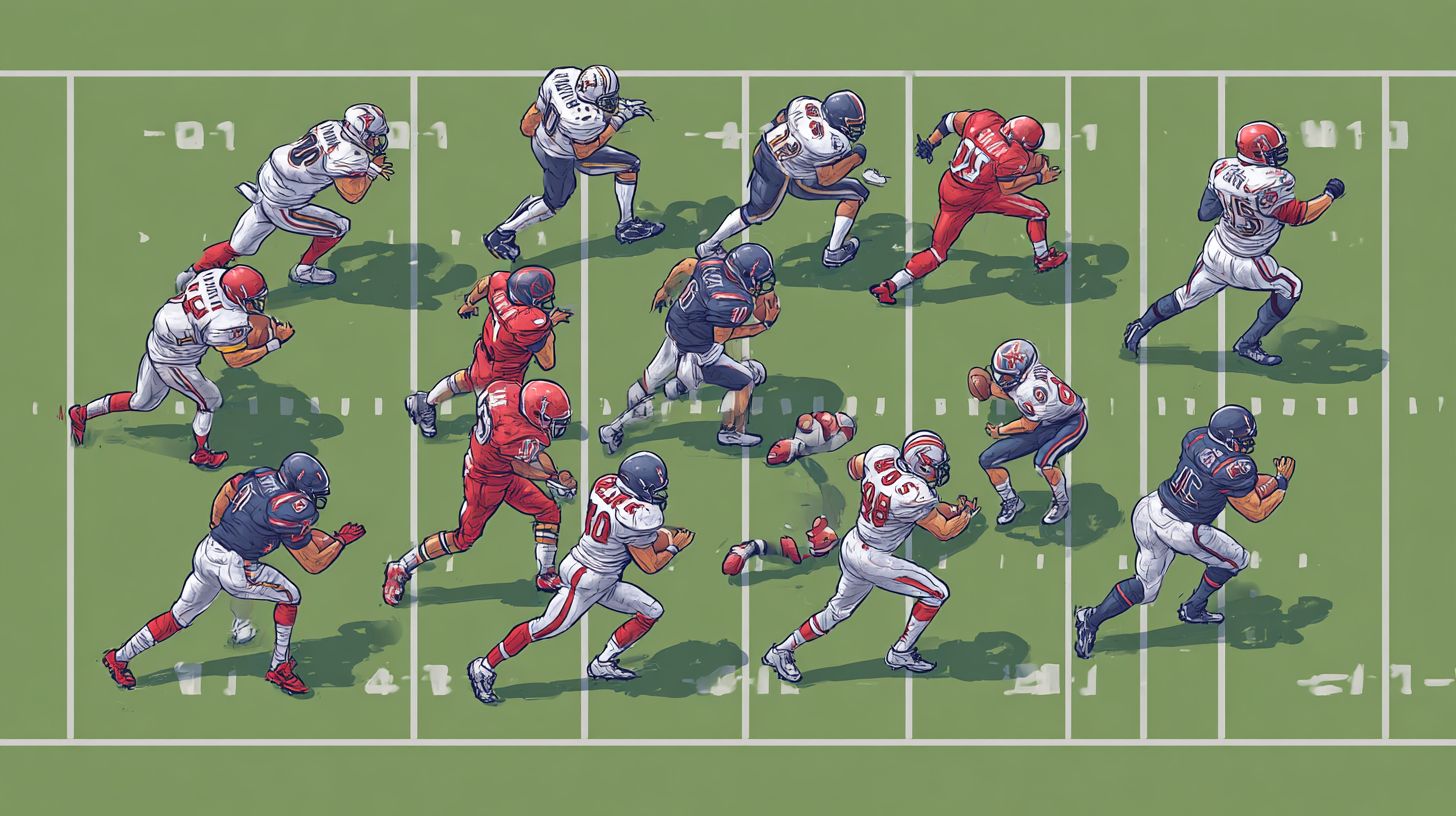
American football positions explained the chaos of a Sunday gridiron clash: 22 players executing intricate roles in split seconds. Mastering American football positions unlocks the sport’s strategic depth, elevating fans from spectators to tacticians.
Explore the offense-from the field general Quarterback (QB) and elusive Running Back (RB) to the trench warriors of the Offensive Line. Then, decode defense: relentless Defensive Line (DL), versatile Linebackers (LB), and agile Secondary. What secrets define victory?
Offense Overview

The offense in American football features 11 players executing complex plays through passing, rushing, and blocking, with the quarterback leading as the pivotal playmaker responsible for 60-70% of a team’s scoring drives per NFL data. This unit aims to advance the ball downfield, scoring touchdowns or field goals. Core roles include the quarterback (QB), who calls plays, plus runners, receivers, and blockers who create space.
NFL average snap counts highlight usage: QB ~65 snaps/game, showing constant involvement, while RB ~20 carries/game emphasizes ground attack balance. Wide receivers run ~50 routes/game, key for passing yards. The offensive line protects and opens lanes, setting up every snap.
Success relies on coordination in formations like shotgun or under center. Play-action fakes and zone blocking schemes add deception. These elements transition into specific positions below for deeper insight.
Teams mix rushing and passing based on down and distance, adapting to defense. Elite offenses control the line of scrimmage, sustaining drives through the red zone.
Quarterback (QB)
The quarterback orchestrates every offensive play, averaging 35-40 pass attempts per NFL game while reading defenses pre-snap within 3-second decision windows. This position demands quick thinking to spot blitz indicators and defensive alignments. Mastery here separates good from elite signal-callers.
Pre-snap, QBs make audibles based on coverage looks, adjusting to man coverage or zone. Drop-back mechanics include 3/5/7 step drops to set in the pocket. Progressions guide reads from WR1 WR2 checkdown, ensuring safe throws.
- Scan primary targets downfield first.
- Step up in the pocket under pressure.
- Use play-action to freeze linebackers.
Footwork drills build accuracy, as seen in Patrick Mahomes’ high completion rates. Elite QBs keep pressure rate under 30% per PFF metrics, with TPRR >2.5 targets/route marking top performers. Practice pre-snap reads to elevate your game.
Running Back (RB)
Running backs carry 15-25 times per game, generating 40% of NFL team yards via vision, patience, and YAC averaging 4.2 yards per NFL carry. They hit holes with burst, reading A/B/C gaps created by blockers. Versatility defines modern RBs in pass-heavy schemes.
Key skillsets include vision reads to find cutback lanes and blocking assignments like reach or latch in pass pro. Receiving from the backfield covers 80% of routes, making them a safety valve. Explosive YAC turns short gains into big plays.
- Press the hole before bursting outside.
- Pick up blitzes with angle blocks.
- Catch screens for immediate yardage.
Combine benchmarks like 4.5s 40-yard dash and 35+ inch vertical aid scouting, as with Derrick Henry’s power style. Elite RBs hit 5.0+ YPC and 60% success rates. Focus on juke moves and spin for evasion.
Wide Receiver (WR)
Wide receivers run 45-60 routes per game, converting 65% of targets into first downs for top performers like Tyreek Hill. They stretch defenses with speed, creating separation on every snap. Route precision wins matchups against cornerbacks.
The route tree breaks down actions: short routes like slant or hitch (0-5 yards), intermediate dig or curl, and deep go or post. Release techniques include speed, hitch, or inside fakes off the line. Gain >2 yards separation to get open.
- Explode off the line with a stutter step.
- Sell double moves like fade-streak.
- Track the ball for contested catches.
PFF notes 25% target share and 2.8+ YPRR as benchmarks for stars. Slot receivers work inside, while outside WRs take top coverage. Master rub routes in bunch sets for easy yards.
Offensive Line
The offensive line’s 5 players generate 2.8 seconds of pocket time per dropback for elite units, blocking 300+ snaps/game across run/pass schemes. These linemen protect the quarterback and open lanes for the running back. Their work sets up the entire offense.
Key responsibilities include pass protection and run blocking. They use schemes like zone blocking to create cutback lanes. Combo blocks help against twisting defensive ends.
Critical protection schemes feature 6-man max protect for heavy blitzes and 21 personnel groupings with extra tight ends. Centers make line calls to ID the Mike linebacker. Average snap counts run high, with centers around 65 per game.
Success here drives offensive output. Elite units limit sacks and boost yards per carry. This leads to specifics on tackles, guards, and centers.
Tackle (T)
Left tackle protects blindside on 90% of dropbacks, with elite LTs allowing <2% pressure rate, like Trent Williams at 1.8% in 2023 PFF grades. Right tackles face similar duties against defensive ends. They anchor the edges.
Pass pro uses kick-slide technique to mirror rushers, with punch timing to stun them. Run blocking involves reach blocks to seal the edge or drive blocks to move defenders. Stance varies from 3-point for power to loose for speed.
Combo blocks start as doubles with guards, then climb to linebackers. Elite tackles hit 85+ PFF pass block grades and run sub-4.2s in the 40-yard dash. They practice footwork drills daily.
Offensive tackles must handle speed rushers with bull rush counters. Their positioning creates a clean pocket for QB drops. Versatility shines in pull schemes too.
Guard (G)
Guards execute 25% of pull blocks in outside zone schemes, creating cutback lanes that boost RB YPC by 1.2 yards per advanced analytics. They dominate inside runs with power. Average weight sits around 320lbs for leverage.
Inside run blocking relies on combo double teams to trap defensive tackles. Pull blocking demands quick get-off to reach the perimeter. Pass pro fights with hands-inside leverage against DTs.
PFF benchmarks show 75+ run block grades for top guards, like Quenton Nelson’s 90.2 in 2023. They shed blocks with violent hand usage. Pulling guards seal edges for sweeps.
Guards excel in trap blocks and screen protection. Their agility opens holes in spread offenses. Coaches drill them on angle drives relentlessly.
Center (C)
Centers snap 100% of offensive plays with <1% bad snap rate for elites, making protection calls that reduce pressures by 15% per Next Gen Stats. They own the A-gap first. Line calls ID rushers and Mike LB.
Snap variations include hard counts to draw offsides and shotgun exchanges. They lead as first blockers on runs up the middle. Elite centers post 95+ PFF overall grades with 10ms reaction time, like Creed Humphrey at 88.5.
Protection schemes hinge on their audibles. They adjust for blitz looks in no-huddle paces. Combo blocks peel off to second-level LBs.
Centers read defenses pre-snap, calling hot routes if needed. Their footwork mirrors guards in pulls. Mastery here stabilizes the whole O-line.
Defense Fundamentals
Defensive fronts generate 55% of NFL turnovers through pressure and gap control across 4-3 and 3-4 schemes. The front 7 handles most responsibilities for defensive stops. Players focus on disrupting the offense early.
Common alignments include the 4-3 over and under, which use four down linemen and three linebackers. The 3-4 okie shifts to three linemen with four linebackers for more blitz options. Coaches pick these based on personnel and opponent tendencies.
Top defenses excel by creating pressure that forces errors. Gap control prevents running back breakthroughs. Linebackers flow to the ball after linemen occupy blockers.
Expert coaches stress read and react principles in these schemes. Players practice stunts to free rushers. This setup plugs A-gaps, B-gaps, and C-gaps effectively.
Defensive Line (DL)
DL players occupy blockers on most snaps, creating more tackle opportunities for linebackers via stunts and penetration. The defensive line anchors the defense. They use power and speed to disrupt plays.
Defensive ends (DE) rush from the edge with speed rush or bull rush. They align in 5-tech or 9-tech positions. Elite DEs win with swim moves or rip moves.
Defensive tackles (DT) control interior gaps in 2-tech or 3-tech alignments. They penetrate to stop zone blocking. Nose tackles (NT) hold the 0-tech spot in 2-gap schemes.
Players train for gap control and pass rush. Examples like Chris Jones show mastery of counter moves. Combine drills test their 40-yard dash and strength.
- DE: Focus on edge contain and upfield speed.
- DT: Shed blocks with stack and shed.
- NT: Absorb double teams to free LBs.
Linebacker (LB)
Linebackers average strong tackle numbers per game for starters, with top MIKE LBs excelling in zone-drop schemes. They read keys and pursue ball carriers. Coverage and run fits define their role.
The MIKE LB handles run fits and spy duties on mobile quarterbacks. WILL LBs drop into coverage and set the edge. SAM LBs blitz or cover tight ends.
Key skills include shedding blocks with rip or swim techniques. They take proper pursuit angles to force or contain. Elite players limit missed tackles through leverage.
Examples like Fred Warner master Cover 3 with sharp reads. LBs play high snap counts. Coaches drill backer keys for quick reactions.
- Practice force player responsibilities.
- Master stack and shed against O-line blocks.
- Flow to the ball in fire zone blitzes.
Secondary Positions
The secondary prevents a large share of passing touchdowns through Cover 1-4 schemes, with elite CBs allowing low completion rates on targets. This group covers most targeted snaps in modern American football. Critical matchups in the pass defense often shape game outcomes.
Cornerbacks and safeties work together in man coverage or zone coverage. In man schemes, CBs use press technique to jam receivers at the line. Zone drops like Cover 3 sky or cloud let safeties read the quarterback from deeper positions.
The secondary aligns in packages like nickel or dime to counter spread offenses. They face route combinations such as floods or levels concepts. Elite units disguise coverages to confuse the QB before the snap.
Safeties provide support against runs and screens, while CBs lock down wide receivers. Mastering these roles demands speed, instincts, and tackling. Teams rely on the secondary to force incompletions and turnovers like interceptions.
Cornerback (CB)
Cornerbacks face numerous targets per game, with shutdown CBs like Sauce Gardner excelling in low completion rates and minimal yards after catch. They mirror wide receivers in man coverage using press, trail, or bail techniques. In zone, they patrol flats or hooks in Cover 2.
Against releases, CBs jam at the line or stem to disrupt routes. Slot cornerbacks, or nickelbacks, handle slot receivers in Cover 3 buzz. Elite players show quick feet, often tested in shuttle runs.
- Press technique bumps the receiver off the line.
- Trail stays hip-to-hip downfield.
- Bail backpedals while facing the ball.
Tackling matters too, as CBs miss open-field tackles at their peril. They support run defense in pursuit angles. Top CBs break up passes and force incompletions in critical red zone snaps.
Safety (S)
Safeties play heavy snaps covering deep thirds as free safeties or boxes as strong safeties, with top duos limiting explosive plays. Free safeties patrol the deep middle in Cover 3. Strong safeties blitz at high rates or support runs.
Hybrid safeties switch between roles in quarters or pattern-match coverages. They use force or contain angles on outside runs. Elite coverage grades come from pass breakups and interceptions.
- Free safety reads the quarterback in post safety roles.
- Strong safety stacks the box for run stops.
- Hybrids match versatile tight ends or slot receivers.
Players like Minkah Fitzpatrick thrive with high coverage snaps and big plays. Safeties call adjustments in the secondary. Their versatility counters play-action fakes and bootlegs effectively.
Frequently Asked Questions
What are the main American football positions explained by group?
American football positions explained typically fall into three main groups: offense, defense, and special teams. Offensive positions include quarterback, running back, wide receiver, tight end, offensive tackle, guard, and center. Defensive positions are defensive tackle, defensive end, linebacker, cornerback, and safety. Special teams cover kicker, punter, and return specialists.
American football positions explained: What does a quarterback do?
In American football positions explained, the quarterback is the offensive leader who throws passes, hands off the ball to running backs, and calls plays. They’re crucial for strategy and often the most visible player, needing strong arm strength, accuracy, and decision-making under pressure.
How are offensive line positions in American football positions explained?
American football positions explained for the offensive line include center (snaps the ball), guards (protect inside), and tackles (protect edges). They block defenders to create running lanes and protect the quarterback, emphasizing size, strength, and coordination.
American football positions explained: Roles of defensive backs
American football positions explained highlight defensive backs like cornerbacks (cover wide receivers), safeties (deep coverage and run support), and nickel backs (extra slot coverage). They prevent passes and tackles, requiring speed, agility, and ball skills.
What is a linebacker in American football positions explained?
American football positions explained describe linebackers as versatile defenders who stop runs, cover passes, and rush the quarterback. Types include middle (MLB), outside (OLB), with skills in tackling, reading plays, and physicality bridging the line and secondary.
American football positions explained for special teams players
American football positions explained for special teams include kicker (field goals), punter (long kicks), long snapper, holder, and returners (punt/kickoff). They handle kicking situations, crucial for field position and scoring, demanding precision and sure hands.