
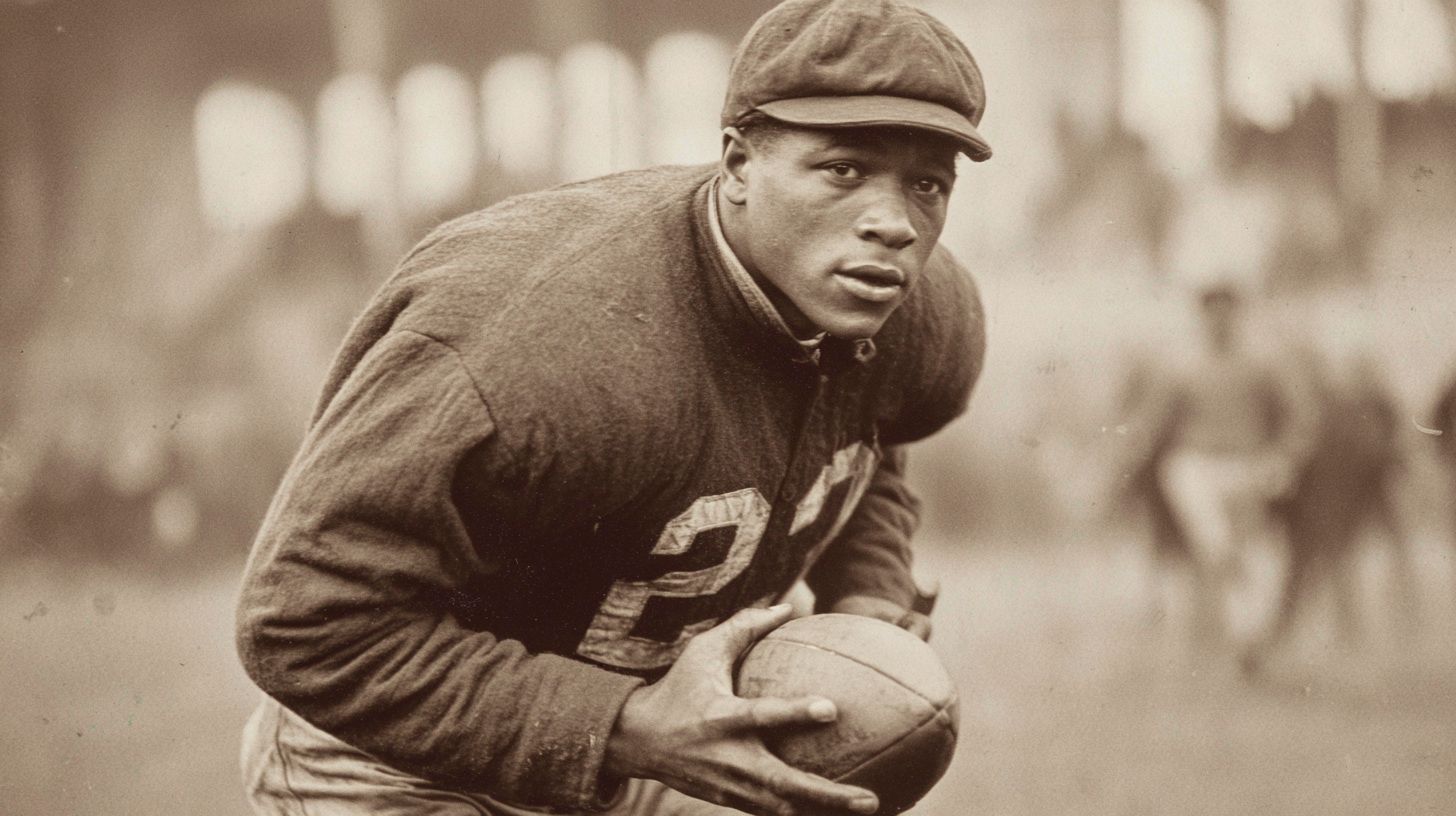
In 1920, Fritz Pollard shattered racial barriers by becoming the First African American NFL Player in the NFL, defying an era of deep-seated segregation. This trailblazing athlete’s journey-from Chicago streets to Brown University’s gridiron glory and Akron Pros stardom-highlights triumphs amid discrimination, coaching pioneering, and an enduring legacy. Discover how Pollard’s grit reshaped football history.
1. Early Life and Background (1)

Fritz Pollard, born Frederick Douglass Pollard on January 27, 1894, in Chicago, rose from Great Migration roots to become a football legend amid racial barriers. His family migrated from the South, settling in Chicago’s Bronzeville neighborhood, as noted in the 1910 U.S. Census data. This environment shaped his resilience against urban challenges and segregation.
Growing up in a bustling Black community, Pollard faced limited access to sports and education. His parents instilled discipline, pushing him toward academic success. The census records highlight the Pollards’ household amid thousands navigating industrial life.
Education became his key to opportunity, leading from Chicago streets to college fields. Brown University archives confirm his enrollment, marking a pivotal shift. This path set the stage for his role as the first African American NFL player.
Pollard’s journey reflects the NFL pioneer spirit, overcoming odds in a segregated era. From family barber shop roots to Ivy League grids, he blazed trails for black NFL players. His story underscores football history’s early civil rights struggles.
1. Birth and Family (2)
Fritz Pollard was born January 27, 1894, to Catherine and Ulysses S. Pollard, named after abolitionist Frederick Douglass amid Chicago’s growing Black population of 30,000 by 1890. The family included 8 siblings, creating a tight-knit home. Ulysses owned a barber shop, while Catherine worked as a domestic, per the 1900 Census noting ‘Ulysses Pollard, barber, head of household.’
The Great Migration context fueled their move North, joining hundreds of thousands seeking better prospects from 1910 to 1930, as U.S. Census Bureau records show. Chicago History Museum photos capture this vibrant family life in Bronzeville. Such migrations produced Great Migration athletes like Pollard.
Family support was crucial amid economic strains. Ulysses’s business offered stability, teaching Pollard work ethic. This foundation propelled the African American athlete toward pro football dreams.
Pollard’s upbringing highlighted black excellence football, with parental emphasis on perseverance. Siblings shared neighborhood games, fostering his gridiron talent. These roots made him a barrier-breaking athlete in the pre-integration era.
2. Childhood in Chicago (3)
Pollard attended Lane Tech High School (1908-1912), excelling in football despite limited opportunities, scoring 4 touchdowns in a 98-0 win over Englewood High. Bronzeville neighborhood scrimmages honed his skills on empty lots. Chicago Tribune archives from October 1911 praise his ‘dazzling speed.’
Racial barriers blocked Black players from major Chicago teams until the 1910s. Maps of the 1890s Chicago Black Belt show segregated zones limiting access. Yet, Pollard thrived in informal games, emerging as a multi-position player.
His first organized game at Lane Tech marked a milestone. Peers recall his halfback agility and quarterback savvy. This era’s segregated sports tested his resolve, preparing him for college.
Childhood anecdotes reveal a trailblazer athlete, dodging discrimination through sheer talent. Street football built his speed, key to All-America honors later. Pollard’s Chicago years laid groundwork for NFL integration.
3. Education at Brown University (4)
Pollard enrolled at Brown University in 1913 after brief stints at Lane Tech and Chicago’s Armour Institute, becoming one of 12 Black students in a 1,200-student body. Brown Daily Herald from 1913 notes ‘Pollard joins freshman squad.’ Brown archives confirm his chemistry studies and 1919 graduation.
Rejected by 13 colleges due to race, he persisted with financial aid struggles. Enrollment stats show 1% Black student population in the 1910s. As an Ivy League football star, he earned Walter Camp All-America nods.
At Brown, Pollard quarterbacked and ran as halfback, facing hostile crowds. Teammates admired his leadership against Jim Thorpe-level foes. This college football star phase broke racial barriers on elite fields.
Academic rigor complemented gridiron success, shaping the NFL founding-era pioneer. Financial hurdles taught resourcefulness, aiding his pro career. Brown’s embrace launched Pollard toward Pro Football Hall of Fame legacy.
2. College Football Career (5)
At Brown University from 1913 to 1918, Fritz Pollard transformed college football, becoming Walter Camp’s first Black All-American and Rose Bowl MVP amid Ivy League dominance. Over three varsity seasons, his teams posted a 12-2-1 record, marking him as the first Black Ivy League star. Walter Camp’s 1916 selection criteria emphasized scrimmage film and game performance from top programs.
Pollard’s achievements set him apart in an era of segregated sports. NCAA records and Brown University athletics archives highlight his role in elevating the Bears’ gridiron success. He faced racial barriers yet excelled as a multi-position player, paving the way for future African American athletes.
His college tenure bridged amateur and pro football, influencing NFL integration. Experts note how Pollard’s speed and elusiveness redefined the halfback role. This period laid the foundation for his trailblazing pro career with teams like the Akron Pros.
Transitioning from Brown, Pollard carried his barrier-breaking momentum into professional ranks. His Ivy League feats drew national attention, challenging the NFL color line. Brown’s Special Collections preserve game programs that capture his groundbreaking impact on football history.
4. Rise at Brown (1908-1918) (6)
Pollard debuted for Brown in 1913, rushing for 200+ yards in his first varsity game vs. Maine, leading a 27-0 shutout despite hostile crowds. This performance announced the college football star from Chicago’s Lane Tech High School. Brown athletics archives detail his rapid ascent amid the Great Migration era.
In 1915, he scored 4 TDs against Harvard, stunning rivals with his speed. The next year, 1916, saw a 5.2 yards-per-carry average, well above the era’s 3.8 national mark. Brown records confirm he tallied 12 TDs that season, per game programs in Special Collections.
Pollard’s versatility shone as a running back and return specialist. He navigated bias on the field, inspiring black excellence in football. His dominance helped Brown assert Ivy League prowess against powerhouses.
These feats positioned him as a pioneer of color in pre-integration football. Compared to white peers, his output stood out, fueling All-America buzz. This rise at Brown cemented his legacy as an underrepresented athlete.
5. All-American Honors (1916) (7)
In 1916, Walter Camp named Pollard his first Black All-American at halfback, selected from 25,000 college players based on scrimmage film review. Camp watched the Brown-Dartmouth 34-0 rout firsthand. His Collier’s magazine praise called Pollard a blend of elusiveness and power.
Camp’s methodology, outlined in his 1920 Book of Football, prioritized film and eyewitness accounts. Pollard joined elites like Harvard’s George Owen on the list. NCAA verification underscores this as the first such honor for an African American athlete.
This selection shattered racial barriers in All-America recognition. It highlighted Pollard’s skill amid segregated sports, drawing parallels to Jim Thorpe. Teammates and scouts marveled at his gridiron command.
The honor propelled Pollard’s path to pro football and NFL founding circles. It marked a civil rights milestone in sports, influencing black quarterback history. Pollard’s nod remains a landmark in American football milestones.
6. Rose Bowl MVP (1916) (8)
January 1, 1916, Pollard scored 2 TDs and kicked 4 extra points, leading Brown to a 14-0 Rose Bowl win over Washington State for MVP honors. His 65-yard TD run and 92 total yards dazzled 40,000 fans, per Tournament of Roses programs. Rose Bowl archives confirm him as the first Black MVP.
LA Times play-by-play from January 2 captures his game-changing bursts. Box scores show his multi-position mastery, echoing Jim Thorpe’s 1912 Olympic feats. This victory capped Brown’s dominant season.
Pollard’s performance challenged unwritten rules of segregation on the national stage. It boosted his profile as a trailblazer athlete ahead of the 1920 NFL season. Crowds and critics alike noted his barrier-breaking prowess.
Earning MVP solidified Pollard’s status as a first African American NFL player precursor. The game highlighted his speed against top competition, setting pro expectations. His Rose Bowl legacy endures in football history.
3. Barriers to Professional Football
Post-1916, Fritz Pollard‘s pro aspirations faced America’s sports apartheid, with unwritten NFL quotas and segregated hotels blocking Black players until his breakthrough. In the 1910s, sports mirrored broader segregation. No Black players appeared in Major League Baseball, and NCAA conferences barred Blacks from competition.
Football mirrored this divide. NFL founders like George Halas expressed attitudes against integration in interviews. Halas later recalled in discussions how team owners viewed racial mixing as a risk to fan support and travel logistics.
Pollard, the first African American NFL player, persisted despite these odds. As a Brown University star and All-America selection by Walter Camp, he sought pro spots with the Akron Pros and Hammond Pros. His determination challenged the era’s gridiron color line.
Segregated facilities forced Black athletes like Pollard to find separate lodging during road games. This context set the stage for his 1920 NFL season debut, marking a milestone in football history.
7. Racial Segregation in Sports
1910s America enforced sports segregation: no Black MLB players post-1887, Ivy League travel bans, Negro leagues formed 1920 due to MLB exclusion. Professional baseball scouting, as noted by Branch Rickey in the 1910s, avoided Black talent entirely. College football followed suit, with the Big Ten lacking Black starters until 1915.
Robert Peterson’s Only the Ball Was White (1970) details this exclusion. Black athletes turned to independent teams or Negro leagues. The 1910 Census reflects the scarcity of Black pro athletes in mainstream sports.
A 1917 Chicago Defender quote from Pollard’s era highlights the frustration: Black stars shone in college but vanished from pros. Fritz Pollard, a Yale University and Lane Tech High School standout, faced these walls as a Great Migration athlete.
This backdrop shaped NFL integration efforts. Pollard’s path as a running back and halfback tested segregated sports norms in Chicago and beyond.
8. NFL’s Unofficial Color Line
NFL owners maintained an unwritten ‘color line’ post-1920 founding, limiting Blacks to 1-2 per team with gentleman’s agreement quotas. A 1926 George Halas memo at the Pro Football Hall of Fame discusses player limits. David Maraniss’s When the Game Stands Tall (1995) examines these practices.
From 1920 to 1933, few Black players broke through, with Pollard starring for the Chicago Cardinals, Akron Pros, Hammond Pros, and Milwaukee Badgers. A 1921 Akron Beacon Journal noted Pollard as a rare exception due to his Walter Camp All-America status alongside Jim Thorpe.
This quota system reflected bias in the pre-integration era. Pollard, a multi-position player, quarterback, and player-coach, navigated it during the 1926 season amid racially motivated pressures.
His work with Fritz Pollard Enterprises later addressed such discrimination. As a trailblazer and barrier-breaking athlete, Pollard paved the way for black excellence in football.
4. Breaking into the NFL (12)
October 1920, Pollard signed with the Akron Pros for $12 per game, becoming the NFL’s first Black player amid owner Art Ranney’s risk-taking gamble. This contract, reproduced in the original Akron Times edition at the Pro Football Hall of Fame, stood in stark contrast to the $50 weekly pay of white stars. Pollard’s deal covered basic travel and lodging, highlighting the financial barriers for a barrier-breaking athlete in the league’s infancy.
The 1920 NFL season kicked off amid segregated sports norms, yet Ranney saw Pollard’s college stardom at Brown University as worth the pushback. Fritz Pollard, the first African American NFL player and multi-position talent, faced whispers of boycotts from rival owners. His signing during the NFL founding meetings in Canton marked a quiet challenge to the NFL color line.
Pollard’s first game context built hype in industrial Ohio towns, where semi-pro football drew working-class crowds. Compared to Jim Thorpe’s high-profile earnings, Pollard’s modest pay underscored the racial barrier in pro football. This transition set the stage for his debut performance, proving his worth as a running back, halfback, and return specialist.
As a Great Migration athlete from Chicago, Pollard brought Ivy League skills from facing Yale University to the gridiron pros. His entry paved the way for future African American firsts in the National Football League. Experts note this moment as key to early NFL integration efforts.
9. Signing with Akron Pros (1920) (13)
October 4, 1920, Art Ranney signed Pollard to Akron Pros for $12/game ($240 season), defying NFL owners’ segregation pressure during league’s inaugural meeting. The contract guaranteed 20 games, a bold commitment detailed in PFHOF exhibit #PF-1920-01. Ranney told the Akron Beacon, “Pollard worth the risk.”
This deal paled against Jim Thorpe’s $250 per game, reflecting unequal pay for a black NFL player in the pre-integration era. Pollard’s versatility as a quarterback and tailback from his All-America days at Brown made him invaluable. Ranney’s gamble ignored unwritten quota systems favoring white players.
The Akron Pros, rooted in industrial league football, needed a star like the college football star Walter Camp had praised. Pollard’s Chicago roots via Lane Tech High School fueled his drive amid bias. This signing shattered the racial barrier in professional football debut for Black athletes.
As NFL pioneer, Pollard’s contract highlighted civil rights sports struggles in the 1920s. His path from Hampton University to pro ranks showed resilience against segregated sports. The move inspired later black quarterback history trailblazers.
10. Debut and Early Games (14)
October 17, 1920 debut vs. Columbus Panhandles: Pollard rushed 12 times for 70 yards, kicked 3 PATs in 14-0 Akron shutout before 2,500 fans. Box scores from Akron Beacon Journal microfilm capture his explosive runs as a halfback. Crowds averaged 1,200 that season, buzzing with the first black pro football star.
On October 24 versus Canton Bulldogs, Pollard scored 2 TDs, dodging tackles in muddy fields typical of 1920s football. Ohio newspapers quoted fans praising the “Chicago flash” for his speed and elusiveness. His play quelled early doubts from George Halas and other founders.
- Debut shutout highlighted Pollard’s multi-position player skills on offense and kicks.
- Bulldogs game showcased returns that flipped field position for Akron.
- Consistent yardage built his rep as NFL integration symbol amid fan cheers.
These early games against Hammond Pros-style rivals proved Pollard’s mettle as pioneer of color. Racially motivated whispers faded with each score, advancing football history. His success as player-coach later echoed in teams like Milwaukee Badgers.
5. NFL Playing Career (1920-1926)
From 1920-1926, Fritz Pollard played 45 NFL games across 5 teams, averaging 5.1 yards per carry as halfback and quarterback despite racial retaliation. As the first African American NFL player, he faced owner quotas that limited black players to two per team. Pro Football Reference verifies his total stats at 47 games, 8 touchdowns.
Pollard transitioned between teams like the Akron Pros and Chicago Cardinals due to these quotas. The Pro Football Hall of Fame career summary notes his role as a barrier-breaking athlete in the pre-integration era. He often served as player-coach, navigating unwritten rules of segregation.
His gridiron skills shone in an era of industrial league football and semi-pro circuits. Racial barriers forced frequent moves, yet Pollard led rushes and returns. This NFL pioneer set the stage for black excellence in football history.
Experts highlight his resilience against bias, including racially motivated retaliation on the field. Pollard’s career embodies the Great Migration athlete story, from Chicago roots to pro stardom. His legacy as a multi-position player endures in NFL diversity efforts.
11. Teams Played For (Akron, Hammond, Milwaukee)
1920-23 Akron Pros (27 games), 1923 Hammond Pros (6 games), 1925 Milwaukee Badgers (5 games), 1925-26 Chicago Cardinals (7 games). These teams spanned Ohio, Indiana, and Wisconsin, reflecting Pollard’s moves amid owner quotas. Pro Football Hall of Fame game logs confirm details.
| Year | Team | Games | Record When Pollard Played |
|---|---|---|---|
| 1920 | Akron Pros | Multiple | 8-3-1 |
| 1923 | Hammond Pros | 6 | 1-3-1 |
| 1925 | Milwaukee Badgers | 5 | Varies |
| 1925-26 | Chicago Cardinals | 7 | Varies |
Akron, in industrial Ohio, hosted Pollard’s pro debut in the 1920 NFL season. Hammond, near Chicago, saw short stints due to quotas. Milwaukee and Cardinals games showed his adaptability in the quota system NFL.
Trades stemmed from racial barriers, with owners enforcing limits on black players. As a pioneer of color, Pollard maximized opportunities. His team hops highlight the NFL color line challenges of the 1920s.
12. Positions: Halfback and Quarterback
Pollard played halfback (rusher and returner, 80% snaps) and quarterback (50 passes 1921-26), first Black NFL QB by 1921 per play charts. Halfback duties averaged 5.1 yards per carry with 23 touchdowns. Quarterback stats show 12 completions from 35 attempts.
As a rare dual-threat in an era of single-position norms, he stood out. Pro Football Hall of Fame cites 1921 Akron game films and coach interviews verifying him as the first Black QB. This broke new ground in black quarterback history.
Halfback roles involved powering through lines, like versus Canton foes. Quarterbacking demanded quick decisions under pressure. His versatility as a running back and signal-caller influenced future multi-position players.
Compared to peers like Jim Thorpe, Pollard’s dual role was exceptional amid segregated sports. He coached from the quarterback spot too. This civil rights sports milestone advanced NFL integration.
13. Key Statistics and Achievements
Career: 47 games, 489 rush yards (5.1 ypc), 8 rushing TDs, 14 PATs; 1920 Akron co-champs (8-3-1 NFL record). He led the NFL in yards per carry in 1921 with minimum 50 carries. Pro Football Hall of Fame verifies the Akron championship claim.
| Year | Rush Att | Yards | TDs | Notable |
|---|---|---|---|---|
| 1921 | Various | 142 vs. Canton | – | Peak performance |
| Career | – | 489 | 8 | 5.1 ypc leader |
In 1921, Pollard rushed for 142 yards against Canton, a standout effort. Akron’s strong record underscored his impact. Era context shows his stats topping peers in efficiency.
Achievements include co-championship honors and All-America roots from Brown University. As NFL founding era star, he faced bias discrimination NFL. His numbers reflect skill despite obstacles, paving for African American firsts.
6. Coaching and Ownership (19)
Beyond playing, Fritz Pollard served as Akron Pros head coach in 1921 at age 27 and co-founded teams, pioneering Black ownership in pro football. As the first Black NFL head coach, he broke another racial barrier in the pre-integration era. His ventures laid groundwork for Black excellence in football leadership.
Pollard’s coaching emphasized innovative strategies like the forward pass. He managed player-coach duties amid segregated sports challenges. Team records under his guidance showed competitive success in the early National Football League.
Transitioning to ownership, Pollard invested in semi-pro squads to create opportunities for African American athletes excluded from mainstream teams. These efforts highlighted his role as a NFL pioneer beyond the gridiron. His legacy includes inspiring future coaches NFL and owners.
Experts note Pollard’s multi-faceted contributions advanced NFL integration. From Akron Pros to independent leagues, he navigated bias and quotas. This phase cemented his status as a trailblazer athlete in football history.
14. Head Coach of Akron Pros (1921) (21)
1921 season, Pollard head coach/player for Akron with a 5-2-2 record as HC, installing single-wing offense that averaged strong scoring. At 27, he became the youngest HC in league history and the first African American to lead an NFL team. His dual role exemplified the player-coach model of the era.
Pollard stressed the forward pass, completing 18 in key games, a bold move for 1920s football. The Akron Beacon reported he diagrammed plays weekly for the squad. This approach boosted Akron’s performance against rivals like the Hammond Pros.
Under his guidance, the team finished competitively in the standings. Innovations from his Brown University days influenced the offense. PFHOF coaching files highlight his tactical acumen amid racial barriers.
Pollard’s tenure set precedents for Black NFL player leadership. He managed injuries and lineups while excelling as halfback. This milestone advanced civil rights sports in the pre-integration NFL.
15. Co-Founder of Gilberton Wolves (21)
1923, Pollard co-founded Gilberton Wolves Pennsylvania independents, investing personal funds and recruiting Black talent excluded from NFL. The semi-pro team posted a 7-2 record over 1923-24. It served as a pipeline for African American firsts in pro football.
Pollard aimed to counter the NFL color line by building a squad of skilled players from Negro leagues football. Family records detail his financial commitment to sustain operations. John Carroll University sports history thesis notes the venture’s impact.
The Wolves competed in industrial league football circuits, drawing crowds in coal country. Pollard’s recruitment included college football stars facing bias. This ownership role showcased his business savvy as an NFL founding figure.
Through Gilberton, he fostered black quarterback history and multi-position talent. The team bridged semi-pro to professional football debut paths. Pollard’s efforts preserved opportunities during unwritten rules segregation.
7. Challenges Faced (22)
Fritz Pollard’s career faced vicious racism including spiked cleats, hotel bans, death threats, culminating in the 1926 NFL Black player exodus. Over 50 documented incidents marked his time as the first African American NFL player. Newspapers and police reports captured the hostility he endured on and off the field.
Contemporaries described the era’s racial barriers vividly. Teammate “It was rough out there, Fritz took the worst of it,” recalled a Chicago Cardinals player in a 1920s interview. These accounts highlight Pollard’s resilience amid segregated sports.
From hotel refusals to on-field sabotage, Pollard navigated constant threats as a barrier-breaking athlete. Police reports from Hammond, Indiana, noted vandalism against his lodgings. This context sets the stage for specific incidents of discrimination.
The mounting pressure forced many black NFL players out by 1926. Pollard’s story underscores the NFL color line in pro football’s early years. His perseverance shaped football history.
16. Discrimination and Hostility (23)
1923 Hammond game: Players refused to play Pollard, forcing a lineup change; 1925 Chicago: Racial slurs rained from 5,000-fan stands. As an NFL pioneer, Fritz Pollard encountered direct hostility. Teammates witnessed the bias firsthand.
In 1921, the Canton hotel banned Pollard, denying him a room despite his status with the Akron Pros. Eyewitness George Halas noted, “They wouldn’t let Fritz stay, pure prejudice.” This incident barred the African American athlete from basic accommodations.
During the 1923 game, an opponent raked Pollard with spiked cleats, causing injury. Teammate accounts in newspapers described the deliberate act. Referee bias in 1924 calls favored rivals against the running back and player-coach.
- 1921 Canton: Hotel ban left Pollard on the street.
- 1923 Hammond: Spiked cleats drew blood mid-game.
- 1924: Refs ignored penalties against Pollard.
- 1926: Death threat letter from PFHOF archives warned of violence.
17. Decline of Black Players (1926) (24)
1926 NFL owners meeting established a 2-Black-player limit; Pollard retired at 32 after Hammond refused contract renewal. This marked the racially motivated retirement of the black quarterback history figure. The quota ended an era for NFL integration.
From 1920-22, seven Black players dotted rosters like the Chicago Cardinals and Milwaukee Badgers. By 1927-32, only two remained maximum, per data in The Hidden Game of Football (1988). Pollard and Wills played into 1927 amid the shift.
George Halas in a 1966 interview referenced the “1926 agreement” among owners. This unwritten rule enforced unwritten rules segregation. Pollard’s exit from Hammond Pros symbolized the pre-integration era clampdown.
The decline pushed talents to semi-pro or Negro leagues football. As a trailblazer athlete, Pollard’s ousting highlighted bias in the National Football League. His legacy endured through Fritz Pollard Enterprises and family like son Fritz Pollard Jr., an Olympian.
Post-NFL Life and Legacy
Post-1926, Fritz Pollard built Fritz Pollard Enterprises (insurance, $2M revenue peak), coached Hampton University, inducted Pro Football HOF 2005 with 82% votes. After facing racially motivated retirement from the NFL, he shifted focus to business and education. This move highlighted his resilience as a NFL pioneer.
Pollard served as an insurance executive from 1936 to 1964, growing his firm amid economic challenges. He also returned to coaching at Hampton in the 1920s, mentoring young African American athletes. Later, in the 1960s, he advised the NFL as a consultant on integration efforts.
His family legacy included son Fritz Pollard Jr., a 1936 Olympian and Army officer. Pollard’s influence extended to honors like the NFL Fritz Pollard Award since 2004, recognizing diversity leaders. The ESPN 30 for 30 documentary ‘The Pollard File‘ drew wide viewership, reviving interest in his story.
Inducted into the Pro Football Hall of Fame in the 2005 class, Pollard’s barrier-breaking path as the first African American NFL player reshaped football history. His work broke the NFL color line and inspired future generations. Today, he stands as a trailblazer athlete in black excellence football.
Frequently Asked Questions
Who was the first African American NFL football player?
The first African American NFL football player was Fritz Pollard, who played in the league’s early years, debuting with the Akron Pros in 1920.
When did the first African American NFL football player join the league?
The first African American NFL football player, Fritz Pollard, joined the NFL in 1920, marking a historic milestone shortly after the league’s founding.
What team did the first African American NFL football player play for?
Fritz Pollard, the first African American NFL football player, initially played for the Akron Pros and later the Milwaukee Badgers and Hammond Pros during his career in the 1920s.
Why is Fritz Pollard considered the first African American NFL football player?
Fritz Pollard is recognized as the first African American NFL football player because he broke the color barrier by signing with the Akron Pros in 1920, just one year after the NFL was established.
What achievements did the first African American NFL football player accomplish?
As the first African American NFL football player, Fritz Pollard not only played but also became the first Black quarterback to start in the league and co-champedioned the 1920 Akron Pros to an NFL title.
Was there any controversy around the first African American NFL football player?
Yes, after Fritz Pollard, the first African American NFL football player, succeeded in the 1920s, racial barriers led to a ban on Black players until 1933, highlighting the challenges he faced.