
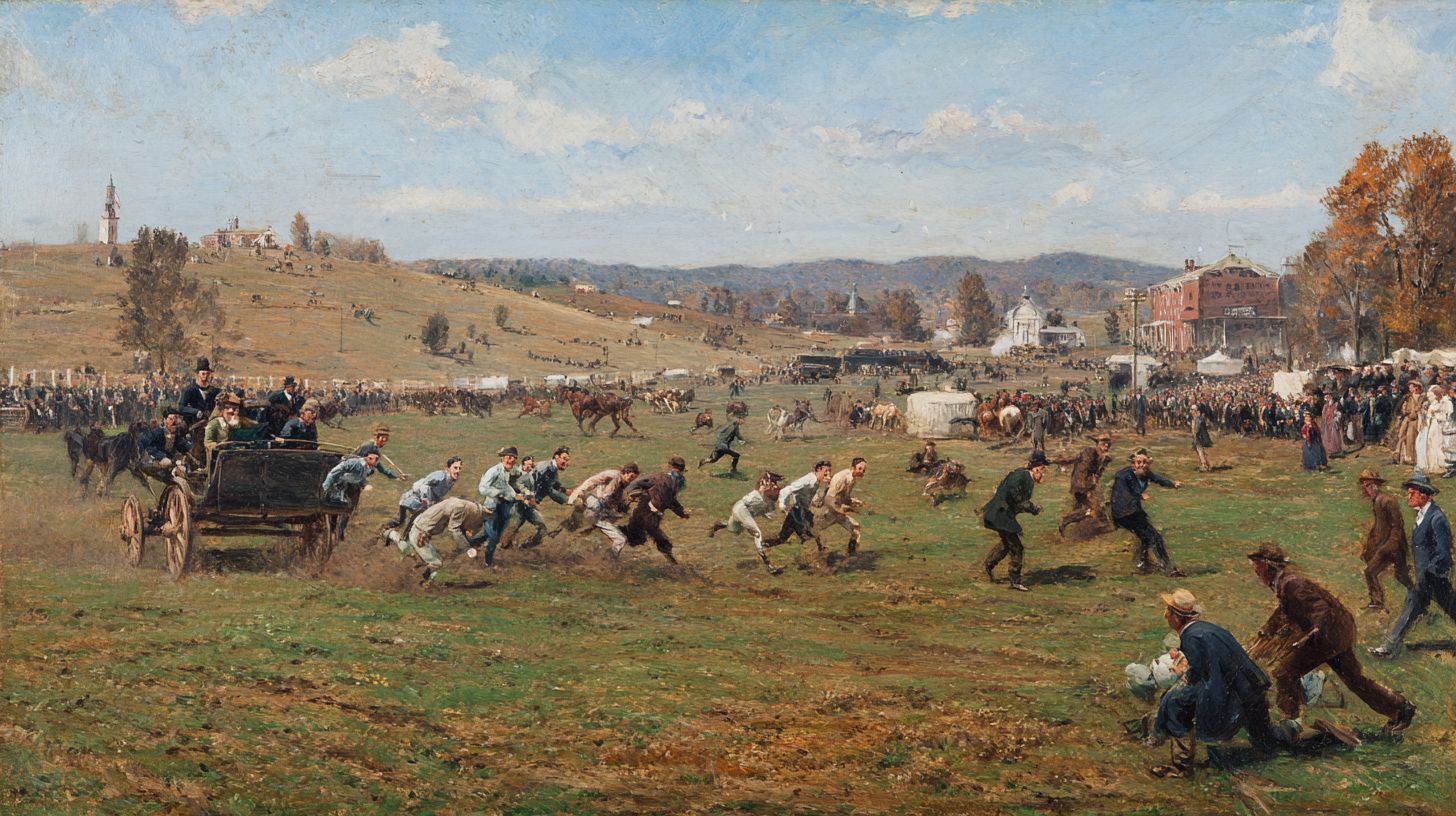
When Was American Football Invented rugby grit and soccer strategy on a Harvard field in 1874, birthing the brutal sport millions now cheer.
American football didn’t spring from nowhere-its roots trace to ancient mob games, English rugby, and pivotal U.S. innovations. This article unravels precursors from medieval Europe, the game-changing Harvard-Yale matchup, Walter Camp’s rules, and why no single date claims “invention,” teasing an evolutionary triumph by 1880.
Defining American Football vs. Other Football Variants

The 1876 rules committee distinguished American football by introducing the snapback and 15-yard first down, absent in rugby’s continuous play. These changes marked a shift from rugby’s flowing scrums to structured possessions. This innovation set the stage for gridiron football as a distinct sport.
Walter Camp’s book American Football, published in 1891, outlined these rule distinctions clearly. He emphasized the line of scrimmage and downs system, which rugby lacked. Camp, often called the father of American football, helped codify these elements during the late 19th century.
Field dimensions further highlight the differences between American football, rugby, and soccer. American fields are longer and narrower, suited to the forward pass and tackling rules. Rugby and soccer fields prioritize open running and kicking.
| Sport | Length x Width |
|---|---|
| NFL | 120 x 53.3 yards |
| Rugby | 100 x 70 meters |
| Soccer | 105 x 68 meters |
The oblong ball shape in American football, a prolate spheroid, contrasts with rugby’s similar but rounder oval and soccer’s sphere. This design aids passing and punting strategies unique to the gridiron. Early games like the 1869 Rutgers-Princeton game used soccer-style balls before evolving.
Understanding these variances helps trace the evolution of football from British roots. Rugby allowed unlimited carrying, while American rules added touchdowns and field goals with numerical scoring. This separation fueled college football’s growth at Yale and Harvard.
Common Misconception: Exact Invention Date
No single person invented football. Google searches for who invented football often highlight Walter Camp or the Princeton-Rutgers game. This reflects confusion over the evolution of football from varied roots.
One common myth credits Walter Camp as the sole inventor in the 1870s. In truth, Camp standardized rules at Yale University through the rules committee. He introduced key features like the line of scrimmage and numerical scoring, but built on earlier games.
Another myth points to the 1869 Rutgers-Princeton game as the birth. That match in New Jersey resembled association football or soccer, with more kicking than carrying the ball. The Pro Football Hall of Fame timeline notes it as an early intercollegiate event, not gridiron football.
A third myth claims 1874 as the creation year during transitional play. Games then mixed rugby and soccer elements, like the Boston Game at Harvard. The Hall of Fame timeline shows this as part of gradual rule changes, not a sudden invention.
American football emerged through collaborative effort in the 19th century. Influences from British sports, Canadian rugby at McGill University, and post-Civil War university rivalries shaped it. Experts view this as sport development over decades, not one date.
Thesis: Evolution from Mid-19th Century Rugby Roots
American football evolved across 15 years: 1869 (kicking game), 1874 (rugby influence), 1880 (modern rules), reaching standardization by Camp’s 1888 reforms. This gradual development transformed British sports like rugby and soccer into gridiron football. No single inventor exists, but key events mark its path.
The Rutgers-Princeton game in 1869 kicked off intercollegiate football as a kicking contest under association football rules. Players used bare hands with no gloves and improvised goalposts from trees. This New Jersey match, ending 6-4 for Rutgers, set the stage for evolution.
By 1874, Harvard’s rugby-style play against Yale introduced carrying the ball, influenced by McGill University games. Walter Camp formed a rules committee in 1876 at Yale to codify changes. The 1880 line of scrimmage added structure, replacing rugby scrums.
| Year | Event | Key Development |
|---|---|---|
| 1869 | Rutgers 6-4 Princeton | First intercollegiate game, kicking focus |
| 1874 | Harvard-Yale rugby | Running plays introduced |
| 1876 | Camp’s rules committee | Early standardization efforts |
| 1880 | Line of scrimmage | Modern possession system |
These milestones preview deeper article sections on college football origins, Camp’s innovations, and rule changes like the forward pass. Explore how post-Civil War universities in New Jersey, New York, and Massachusetts shaped this team sport.
Early Ball Games in Europe and America
Roman harpastum from the 1st century AD featured tackling for oval balls. This game directly ancestral to rugby per Oxford University studies. Players scrambled to control the ball in rough play.
Ancient games laid groundwork for American football origins. These rough contests involved teams pushing against each other. They mixed kicking, carrying, and tackling in open fields.
Four key precursors shaped the evolution of football:
- Episkyros in Greece around 400 BC, where teams threw and caught a ball over lines while shoving opponents.
- La Soule in France during the 12th century, a chaotic village game with hundreds chasing a leather ball across countryside.
- Knattleikr among Vikings, combining stick-handling and physical contact in brutal matches on ice or grass.
- Pasuckuakohowog played by Native Americans, featuring kicking and throwing a stuffed deerskin ball between goals.
British Library manuscripts depict medieval folk football scenes with mobs clashing over balls. These images show unruly crowds in mob football traditions. Such visuals highlight ties to early gridiron football roots.
Mob Football and Its Violent Traditions
England’s 14th-century mob football killed 17 players in one 1314 match, per Edward II’s ban citing ‘great noise’ and injuries. These chaotic games involved entire villages chasing a ball through fields and streets. Players faced broken bones and worse in the unregulated frenzy.
A 1349 royal ordinance banned football to prioritize archery practice for national defense. Authorities saw the sport’s violence as a threat to public order and military readiness. This edict highlighted how medieval football disrupted communities with its brutality.
David Goldblatt’s The Ball is Round (2006) traces these folk football roots to modern sports like soccer and rugby. Games lacked fixed rules, teams, or fields, resembling riots more than organized play. Such traditions influenced early American versions before gridiron football emerged.
Compared to today’s NFL, where injuries occur at rates far exceeding mob football’s documented deaths, the ancient game’s dangers were extreme. Modern leather helmets and tackling rules evolved from these violent origins. Understanding this history shows American football’s path from chaos to structured competition.
Rugby Football’s Emergence in England (1820s-1860s)
The 1845 Cambridge Rules banned carrying, while Rugby School permitted it, creating the sport’s fork that reached Harvard by 1871. This split marked a key moment in football history, separating kicking games from those allowing ball handling. Rugby’s rough style drew from earlier folk games.
The Webb Ellis legend dates to 1823, when William Webb Ellis reportedly picked up the ball at Rugby School and ran with it. Though likely a myth, it symbolizes the birth of carrying in the sport. Accounts appear in school yearbooks and alumni records.
By 1845, Rugby School formalized rules permitting tackling and carrying, contrasting with Cambridge’s no-handling code. These Rugby rules spread through British schools, influencing global variants. Yearbook scans from the era show early matches with tree goalposts.
In 1863, the FA soccer split created association football, focusing on kicking only. Rugby players rejected this, leading to the 1871 RFU founding. This established rugby union as a distinct code, paving the way for American adaptations like gridiron football.
Harvard’s Early Rugby-Style Games (1870s)
Harvard’s ‘Boston Game’ (1872) allowed carrying but no tackling below waist, played against Tufts with 40-yard goals. This version blended rugby and soccer elements. It marked a key step in the evolution of football from British sports.
Players could run with the ball, but rules limited violence compared to full rugby. Harvard Athletics records note these games emphasized kicking and carrying. The Boston Game differed from Yale’s preference for soccer-style play.
The Harvard Advocate in 1873 quoted, ‘Rugby rules too brutal.’ This reflected concerns over injuries in rougher matches with McGill University. Harvard stuck to its milder rules, avoiding full tackling rules.
Yale favored association football, or soccer, leading to disputes in early intercollegiate games. Harvard’s approach influenced the sport’s development toward gridiron football. These 1870s contests in Massachusetts set the stage for rule changes by Walter Camp.
Rules and Style Borrowed from McGill University
Harvard adopted McGill University’s rugby rules after a 1874 trip to Montreal. The game featured 20 players per side and scrums behind the line of scrimmage. Forward passing remained prohibited, keeping play focused on running and kicking.
McGill played with h-shaped goals, unlike Harvard’s soccer-style crossbars. This difference highlighted early divides in American football origins. The Montreal matches exposed Harvard players to a more structured rugby style from Canadian rules.
After the trip, Harvard pushed for hybrid rules blending both traditions. Post-1874 games mixed McGill’s rugby elements with Boston Game customs. This shift marked a key step in the evolution of football.
| Aspect | McGill Rules | Harvard/Boston Game | Post-1874 Hybrid |
|---|---|---|---|
| Goal Structure | H-shaped posts | Soccer-style crossbars | Hybrid posts adopted |
| Team Size | 20 players/side | Variable, often 11-15 | Standardized to 15, then 11 |
| Scrums | Behind the line | Free-for-all rushes | Organized behind line |
| Passing | No forward passes | No forward passes | No forward passes initially |
An eyewitness in the McGill University Gazette described the action vividly. “The ball was carried by hand, with scrums forming tightly,” the account noted. Such reports capture the raw energy of these intercollegiate football pioneers.
These borrowed rules influenced gridiron football development at Harvard and Yale. They bridged rugby and emerging American styles. Walter Camp later refined them into modern formats.
Shift from Soccer to Rugby-Influenced Play
Pre-1874 games, like the Rutgers 6-4 Princeton 1869 match, used soccer rules. Post-1874, running became dominant as noted in Parke H. Davis’s Football from 1911. Teams introduced mauling tactics that shifted play toward rugby styles.
Early contests followed association football guidelines with constant kicking and minimal handling. The 1874 changes allowed more carrying the ball, sparking the evolution of football. Colleges like Rutgers and Princeton adapted quickly to these rugby-influenced rules.
Parke H. Davis documented how mauling emerged in 1874, letting players push opponents while holding the ball. This marked a key step in gridiron football development. Running plays soon overshadowed the kicking game of soccer origins.
| Era | Field Features | Key Changes |
|---|---|---|
| Pre-1874 | Soccer-style pitch, no yard lines | Kicking dominant, minimal running |
| Post-1874 | Emerging yard markers, goal crossbars | Mauling and carrying introduced |
| 1880s Onward | Gridiron layout with end zones | Line of scrimmage, tackling rules |
This field evolution shows the birth of American football as distinct from soccer. Universities in New Jersey and New York drove these shifts. The diagram highlights how 19th century rule changes created modern field dimensions.
Eyewitness Accounts and Contemporary Reports
Yale’s Eli reported: Harvard brought Canadian rugby, rougher than soccer-we tied 0-0 after brutal scrums. This eyewitness account from the May 16, 1874, Yale Daily captured the raw energy of early intercollegiate football matches. Players described chaotic scrums and physical play that blended rugby and soccer elements.
The Harvard Advocate echoed these details in its coverage of the Yale-Harvard game. Reporters noted how Harvard introduced Canadian rugby tactics, leading to a tense 0-0 tie. These contemporary reports highlight the evolution of football from rough, unstructured contests.
A New York Times article from the same period described the first football game intensity at Yale. It quoted spectators on the gridiron football brutality, with players tackling without modern padding. Digitized scans of these pages show faded ink and excited headlines from the 1870s.
Player letters, like those from Yale alumni, add personal insight. One letter detailed McGill University influences and the shift from Boston Game rules to carrying the ball. Archives preserve these primary sources, including scans of handwritten notes on American football origins.
Reduction of Players from 15 to 11 (1880)
The 1880 rules cut players from 15 to 11 per side. This change, driven by the Intercollegiate Football Association (IFA) rulebook, created specialized positions like quarterback and ends. It marked a key step in the evolution of football from rugby-like chaos to structured gridiron play.
Before 1880, teams fielded 15 players with a 25-yard sphere ball, emphasizing mass formations. The IFA rulebook standardized the game, reducing numbers to foster strategy. Walter Camp, often called the father of American football, influenced these reforms at Yale University.
This shift introduced the 11-man line, with clear roles for offensive line, halfback, and fullback. Players now focused on blocking rules and line of scrimmage tactics. The change sped up the sport’s development post-Civil War era.
| Pre-1880 Setup | 1880 Changes (IFA Rulebook) |
|---|---|
| 15 players per team 25-yard sphere ball Mass plays, no specialization Rugby-influenced scrums |
11 players per team 11-man line Quarterback snapback Ends for eligibility rules Defined positions |
The table shows how positions evolved, paving the way for modern American football. Colleges like Harvard and Princeton adopted these quickly. It boosted intercollegiate football popularity in the 19th century.
Creation of the Quarterback and Down System
Walter Camp coined ‘quarterback’ in 1880 for the snapper position. This role evolved from rugby’s scrum-half into American football’s central signal-caller. The term marked a shift toward structured player positions in the sport’s development.
In 1882, Camp introduced the 5-yard rule over three downs, later adjusted to 4 downs in 1906. Teams had to gain that distance or lose possession. This created the downs system, adding strategy to gridiron football.
The rules committee formalized positions like quarterback (QB) as the play-caller, halfback (HB) as primary runners, and fullback (FB) as blockers. An 1882 rule excerpt stated, “The man who catches the ball from the snapper-back is to be called the quarterback.” These roles standardized offensive plays.
Early games used the snapback to start each down from the line of scrimmage. QBs directed HBs on runs and FBs on blocks, preventing mass interference. This system laid groundwork for modern tactics in college football.
Legalization of Interference (Blocking, 1888)
Walter Camp’s 1888 ‘interference’ rule legalized screening blocks, enabling running lanes vs rugby-style tackling. This change allowed offensive players to block defenders without direct contact. It marked a key step in the evolution of football from rugby roots.
The new rule stated, ‘Player may block opponent legally.’ Teams could now shield ball carriers effectively. This shifted strategy toward gridiron football tactics, distinct from soccer or association football.
Before 1888, plays resembled the Boston Game or Canadian rugby from McGill University. Legal blocking rules opened paths for halfbacks and fullbacks. It boosted college football excitement at Yale University and Harvard University.
Interference reduced mass tackling chaos. It paved the way for positions like the offensive line. Yet, it led to dangerous flying wedge formation, later banned in 1894 after injuries.
- Flying wedge crammed players into a tight V-shape to bulldoze defenders.
- Rules committee, led by Camp, outlawed it for safety.
- This pushed the sport toward open plays and eventual forward pass.
Scoring System Standardization (1883)
In 1883 rules established by Walter Camp and the rules committee, a touchdown was worth 4 points, a goal after touchdown earned 2 points, and a field goal counted for 5 points. These values were later adjusted to the familiar 6/1/3 system. This numerical scoring aimed to make American football more precise than rugby or soccer influences.
Standardization reduced disputes in intercollegiate football games, especially during Yale’s dominance. For example, Yale crushed Wesleyan 113-0 in one lopsided match, highlighting the need for clear points. Teams could now strategize around touchdowns and field goals with consistent value.
The rules committee, led by Yale University innovator Camp, met yearly to refine scoring. This built on 1870s Rutgers-Princeton games, evolving from vague kicking games to structured gridiron football. Players focused on carrying the ball and tackling rules under these guidelines.
| Year | Touchdown | Goal After TD | Field Goal | Key Change/Example |
|---|---|---|---|---|
| 1883 | 4 pts | 2 pts | 5 pts | Initial system; Yale 113-0 vs Wesleyan |
| 1885 | 4 pts | 2 pts | 5 pts | Safety added at 4 pts |
| 1898 | 5 pts | 1 pt | 5 pts | Touchdown boosted |
| 1904 | 6 pts | 1 pt | 3 pts | Field goal reduced; modern base set |
By 1904, these shifts favored offensive plays like the forward pass introduction. Rule changes supported college football growth, paving the way for professional leagues. This era marked key sport development in the late 19th century.
Early Pro Games (1890s)
On November 12, 1892, Allegheny defeated Pittsburgh AC 4-0 in the first documented professional football game. William “Pudge” Heffelfinger, a star from Yale, played for Allegheny and earned a $500 season salary, marking the shift from amateur college play to paid pros. This Pittsburgh matchup signaled the birth of professional football amid the sport’s growing popularity.
By 1895, the pro scene expanded with six teams competing in western Pennsylvania, including the Pittsburgh Athletic Club and Allegheny. These early games drew crowds eager for the rough gridiron action refined from rugby roots. Players like Heffelfinger brought college skills to pro fields, boosting the evolution of football.
The Pittsburgh Post-Gazette captured the excitement, noting how Heffelfinger’s performance “turned the tide” in that 1892 clash. Newspapers chronicled these matches as key steps in professional football origins. Such reports from primary sources highlight the transition from college dominance to paid leagues.
These 1890s contests laid groundwork for future pros, influencing rules like tackling and the forward pass later on. Teams played on makeshift fields with basic gear, echoing the 19th century innovations by Walter Camp. Early pro games fueled the sport’s spread beyond universities in New Jersey and New York.
Collegiate Dominance and Fan Growth (1880s-1900s)
Yale won 13 straight championships from 1880 to 1892, drawing 45K to the 1893 Harvard game. This era marked collegiate dominance in American football, with Ivy League schools like Yale and Harvard leading the sport’s evolution. Fans flocked to see these rivalries, boosting the game’s popularity.
By 1888, the Yale-Harvard matchup drew 15K spectators, showing rapid fan growth. Attendance soared to around 50K by 1901 for major games. College football became a cultural event, drawing crowds from across New England.
Thanksgiving tradition took hold in the 1890s, with annual Harvard-Yale clashes on the holiday. These games solidified football as a fall sport, blending family gatherings with intense competition. Newspapers hyped the events, fueling national interest.
Key figures like Walter Camp refined rules during this time, introducing the line of scrimmage and numerical scoring. Yale’s success, including multiple national titles, inspired other universities to adopt intercollegiate football. This period laid groundwork for professional leagues and lasting rivalries.
NCAA Formation and Rule Codification (1906)
The 1906 reforms introduced the forward pass, reduced mass plays, and created a predecessor to the NCAA after President Theodore Roosevelt’s threat to ban the sport. Roosevelt sent a White House letter urging university presidents to address football’s dangers, including numerous deaths from brutal formations. This pressure led to swift action by college leaders.
Key figures formed the Intercollegiate Athletic Association of the United States, later renamed the NCAA, to standardize rules and ensure safety. The reforms shifted American football toward a more open game, emphasizing strategy over brute force. Walter Camp, the father of American football, influenced these changes through the rules committee.
A major innovation was the legal forward pass, limited to 20 yards at first, which opened up the field. Teams adopted a minimum roster of 6-3-3-3 players, with six backs, three ends, three tackles, and three guards. Other updates included numerical scoring and limits on momentum plays.
- Legal forward pass from behind the line of scrimmage.
- Minimum squad size of 22 players in 6-3-3-3 formation.
- Touchdown worth six points, field goal three.
- Elimination of the flying wedge and mass interference.
- Reduced substitutions to prevent fatigue-driven injuries.
- Introduction of the neutral zone to limit piling on.
- Standardized field dimensions with yard lines.
- New tackling rules to curb unnecessary roughness.
- Eligibility restrictions for player safety and fairness.
- Official referees with greater authority on the field.
- Downs system refined to four attempts for ten yards.
- Snapback formalized for quarterback control.
- Positions like halfback and fullback clearly defined.
- Overall push toward a passing game introduction.
Why 1874 or 1876 is Often Cited as “Invention”
In 1874, Harvard introduced Yale to a rugby-style game during their first intercollegiate match, marking a key moment in American football’s development. This event shifted college play away from pure soccer toward carrying the ball, blending British influences with local adaptations. Historians point to it as an early pivot in the evolution of football.
By 1876, Walter Camp helped form the Intercollegiate Football Association at a rules meeting in Massachusetts. This group standardized elements like the snapback and numerical scoring for touchdowns and field goals. Such changes distinguished gridiron football from rugby union.
Sources like Wikipedia cite both dates, yet experts favor an evolutionary view over a single invention. No one person created the sport; it grew from collaborative rule changes in the 1870s. This gradual process involved Yale University, Harvard University, and Princeton.
| Year | Event | Key Impact |
|---|---|---|
| 1874 | Harvard-Yale rugby game | Introduced ball-carrying tactics |
| 1876 | IFA rules committee forms | Added downs system, line of scrimmage basics |
| Context | Post-Civil War college rivalries | Set stage for intercollegiate football |
This table compares the claims, showing how each date contributed to football history. The 1874 game highlighted physical play, while 1876 brought structure through Camp’s innovations. Together, they represent the sport’s origins in the Ivy League era.
Ancient and Medieval Precursors
Football’s deepest roots trace to ancient China’s cuju (200BC) and medieval Europe’s mob football, where entire villages chased inflated pig bladders. These games featured carrying and running with the ball but lacked any formal rules. Players often resorted to violence in chaotic matches across fields.
British Museum artifacts show early leather balls used in folk games, hinting at influences on later sports like American football. David Goldblatt’s Football: A History draws from primary sources to detail these precursors. The book highlights how violent tackling shaped the sport’s physical nature.
In medieval Europe, mob football involved hundreds clashing over a pig’s bladder toward village goals. No referees or boundaries existed, making games brutal tests of endurance. These traditions carried into colonial America, inspiring early gridiron football evolutions.
Ancient cuju required kicking a feather-stuffed ball through holes, blending soccer and skill elements. Such games spread via trade routes, influencing rugby and association football. Experts trace American football’s invention partly to these unstructured origins.
3. Direct Antecedents in the 19th Century
Rugby’s 1823 Rugby School incident-William Webb Ellis allegedly running with the ball-evolved into codified rules by 1845, crossing to America post-Civil War. British exports via universities shaped US college sports. This influence laid groundwork for American football’s invention.
Harvard Crimson archives document early games blending rugby and soccer elements. Students at Harvard University and Yale played variants after the Civil War. These matches featured carrying the ball alongside kicking, mirroring association football.
The Rugby Football Union formed in 1871, standardizing rules across Britain. American colleges adopted similar formats, leading to the 1869 Rutgers-Princeton game, often called the first intercollegiate football contest. Disputes over rules highlighted the need for codification.
Key figures like Walter Camp emerged in the 1870s, pushing innovations such as the line of scrimmage and tackling rules. This era marked gridiron football’s shift from chaotic rugby-style play to structured college football. Universities in New Jersey and New York pioneered these changes.
4. The Pivotal 1874 Harvard-Yale Game
The May 15, 1874 Harvard-Yale match at New Haven’s Hamilton Park introduced rugby rules to the Ivy League, scored 0-0 before 300 spectators. This intercollegiate football clash marked a turning point in the sport’s evolution. It shifted play from soccer-style kicking to rugby’s ball-carrying tactics.
The Yale Daily News contemporary report captured the excitement of this gridiron football experiment. Harvard, fresh from matches with McGill University, pushed for Canadian rugby rules over the kicking game. Yale players adapted quickly, leading to a tense stalemate.
This game birthed modern American football by blending soccer and rugby elements. It set the stage for rule changes in the 1870s, influencing figures like Walter Camp. Spectators witnessed the origins of carrying the ball and tackling rules.
Key differences emerged, such as no numerical scoring yet, but the Harvard-Yale game sparked rivalries. It paved the way for intercollegiate standardization. Historians view this as a core event in football history.
5. Walter Camp’s Transformative Role (1876 Onward)
Walter Camp, Yale’s father of football, chaired 18 rules committees from 1876 to 1925. He turned the chaotic early games between rugby and soccer into a structured sport. His work marked a key step in the evolution of football.
Camp introduced seven core features between 1876 and 1888. These included the line of scrimmage, snapback, and downs system. They shifted gridiron football from constant scrums to organized plays.
In his book American Football, Camp detailed these changes across 86 editions. He explained numerical scoring for touchdown and field goal. This text became a bible for coaches and players.
Camp’s innovations, like the 11-player teams and quarterback position, standardized the game. Yale’s dominance under him fueled intercollegiate football rivalries. His legacy shaped college football and influenced NFL origins.
6. Key Rule Changes Defining Modern Football (1880s)
From 1880 to 1888, rules transformed the rugby brawl into a chess match with numerical scoring and blocking. The Intercollegiate Football Association (IFA), formed in 1876, drove these shifts through its minutes. Walter Camp, often called the father of American football, led the rules committee at Yale University.
The IFA standardized the line of scrimmage in 1880, replacing rugby scrums with organized plays. Teams snapped the ball back from this line, creating positions like quarterback, halfback, and fullback. This change emphasized strategy over chaos in college football.
In 1882, Camp introduced the downs system, requiring four attempts to gain ten yards. Failure meant turnover, adding tension and planning. IFA minutes record debates on this, balancing offense and defense.
Blocking rules in 1888 allowed interference without tackling the runner first. Numerical scoring assigned points to touchdown, field goal, and other plays. These rule changes marked the evolution from rugby to gridiron football.
7. First Professional Elements and Spread
Pro football emerged in 1892 when William ‘Pudge‘ Heffelfinger earned $25 per game, three times typical college expense money. According to Pro Football Hall of Fame records, Heffelfinger played for the Allegheny Athletic Association against the Pittsburgh Athletic Club. This marked the shift from amateur college dominance to paid players filling growing demand.
Colleges like Yale University and Harvard led intercollegiate football, but working-class fans sought local teams. Early pros played on Sundays, drawing crowds excluded from college schedules. Heffelfinger’s success as the first pro player encouraged others to follow.
The sport spread beyond New England through industrial towns in Pennsylvania and Ohio. Teams formed in mill communities, blending gridiron football rules with rugby styles. By the early 1900s, professional leagues emerged amid college popularity.
- Allegheny games drew thousands despite rough fields.
- Players used pigskin balls and minimal gear like leather helmets.
- Thanksgiving matchups boosted attendance nationwide.
These professional football roots laid groundwork for NFL origins, evolving from informal payouts to structured competition. The transition highlighted football’s appeal as an American pastime.
Official Recognition and Legacy
The 1906 ‘open game’ legalized the forward pass after 18 college deaths in 1905, birthing modern strategy. This rule change addressed the dangers of mass plays like the flying wedge. It marked a turning point in American football’s evolution.
Theodore Roosevelt pushed college presidents to reform the sport for safety. He threatened to ban football unless changes occurred. This intervention led to the creation of the Intercollegiate Athletic Association, later the NCAA in 1906.
Walter Camp served on the rules committee, standardizing elements like the line of scrimmage and downs system. These innovations built on rugby and soccer influences from the 1870s Rutgers-Princeton game. The NCAA’s founding ensured regulation and codification.
Football’s legacy grew through college rivalries, such as Harvard-Yale games, and professional leagues. Early pros like Pudge Heffelfinger paved the way for the NFL. Today, the sport’s heritage includes the Pro Football Hall of Fame and Super Bowl traditions.
Frequently Asked Questions
When was American football invented?
American football was invented in the late 19th century, evolving from rugby and soccer. The key moment came in 1874 when Walter Camp, often called the “Father of American Football,” introduced rule changes at Yale University that distinguished it from its European roots, with modern rules solidifying by 1880.
What year is considered the birth of American football, and when was American football invented?
The birth of American football is typically dated to 1869, with the first intercollegiate game between Rutgers and Princeton. However, when was American football invented as a unique sport? It was 1874-1876, through Walter Camp’s innovations like the line of scrimmage and downs system.
Who is credited with inventing American football, and when was American football invented?
Walter Camp is credited with inventing the distinctive features of American football while at Yale. When was American football invented in its recognizable form? Around 1876, when Camp’s rules, including reducing players from 15 to 11 per side, were adopted.
How did American football originate, including when was American football invented?
American football originated from English rugby and association football brought by immigrants. The pivotal invention happened post-Civil War; specifically, when was American football invented? In 1874 during a rules meeting at Yale, where hybrid rules were first formalized.
When was American football invented compared to rugby?
Rugby dates to 1823, but American football diverged in the 1870s. Precisely, when was American football invented as distinct? In 1880, when the Intercollegiate Football Association standardized Camp’s rules, leading to the sport we know today.
What event marks when American football was invented?
The 1876 rule changes by Walter Camp, establishing snaps and scoring, mark the invention. To answer directly: when was American football invented? Late 1870s, with the first championship in 1880 under unified rules.