
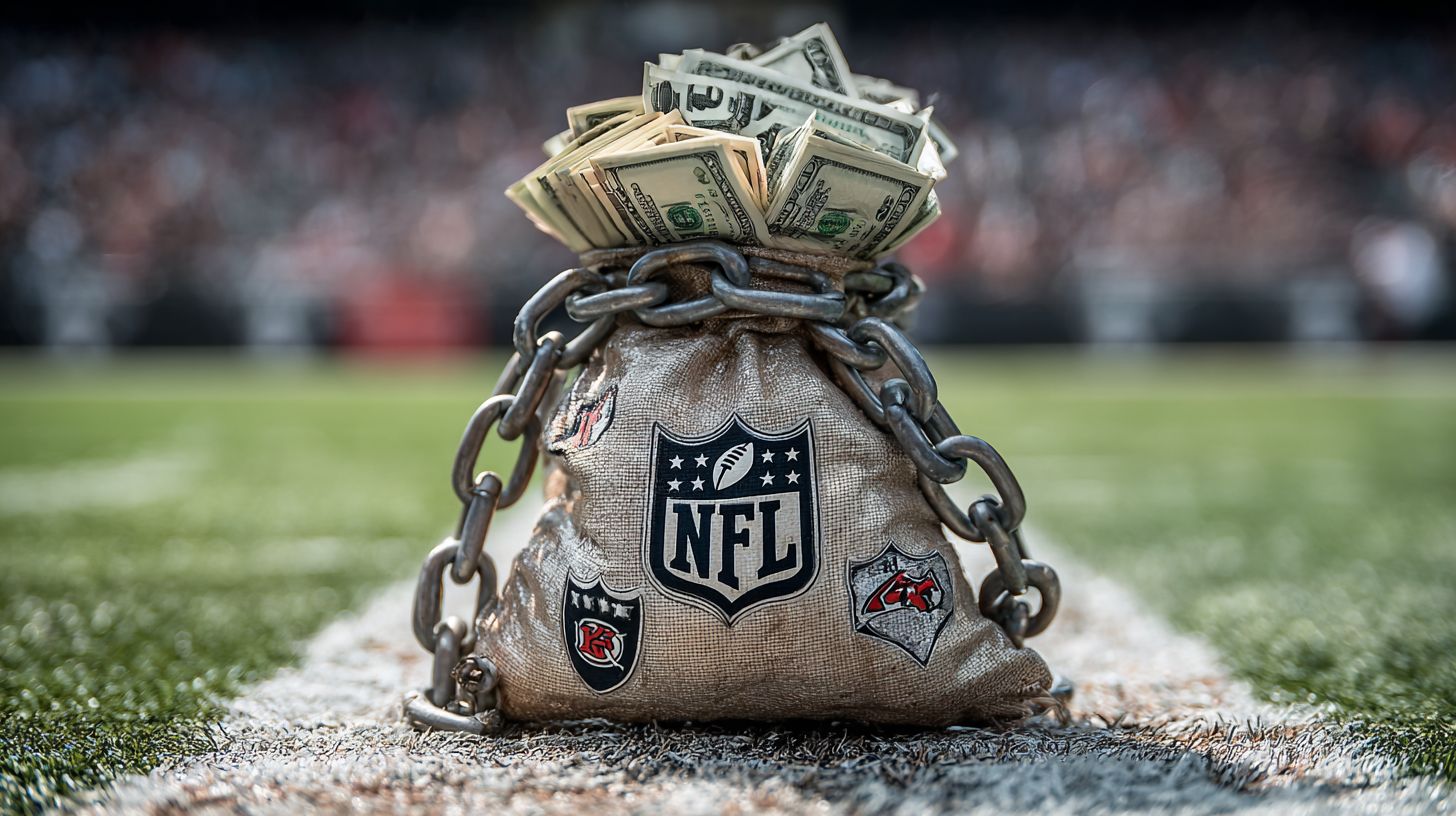
Imagine securing a Super Bowl contender while juggling a 255.4 million team budget-welcome to the NFL salary cap’s high-stakes game.
This financial equalizer, born from the 1994 CBA, ensures parity by tying spending to league revenue from media deals, tickets, and merchandise.
Discover cap calculations, player charges like dead money and bonuses, clever management strategies, exceptions, penalties, and projections through 2030-decode the gridiron economics that shape champions.
Definition and Core Purpose

The NFL salary cap is a hard limit of $255.4M per team in 2024, calculated as 48.23% of player-designated revenue. This cap comes from CBA Article 12 in the collective bargaining agreement. It sets an annual spending ceiling for player contracts on each roster.
The core purpose of the salary cap is to promote fairness across the league. It acts as a hard cap, meaning teams cannot exceed it without penalties. This rule stems from negotiations between the NFL and the players’ union.
Key purposes include four main goals. First, it fosters parity by reducing talent gaps between teams. Second, it controls costs on the roughly $12B player pool.
- Third, it helps prevent holdouts by structuring incentives around cap compliance.
- Fourth, it ties into revenue sharing from TV deals and ticket sales.
Teams track their status with tools like the OverTheCap.com cap tracker. For example, it shows real-time cap space and cap hits for all 32 teams. General managers use this to plan cap management moves like restructures or cuts.
Historical Implementation (1994 CBA)
The salary cap began with the 1993 CBA (effective 1994) at $34.6M per team after the players’ strike. This agreement, detailed in the NFLPA 1994 agreement PDF, introduced a hard cap to balance competition and revenue sharing. Teams had to achieve cap compliance by adjusting player contracts.
Prior events shaped this system. Revenue sharing started in 1982, leading to labor tensions. The 1987 decertification allowed antitrust lawsuits, forcing negotiations toward the 1993 CBA.
The cap has grown steadily since. From $34.6M in 1994 to $255.4M in 2024, it reflects a 638% increase driven by TV deals and revenue growth. This evolution supports cap management strategies like restructuring contracts.
One exception occurred in the uncapped 2010 year, when teams spent freely before the next CBA. Players gained from higher earnings, but it highlighted risks of unlimited spending. Modern collective bargaining agreements maintain structure for financial flexibility.
How the Salary Cap is Calculated
The NFL salary cap follows an annual process that begins with March projections and finalizes in September. This timeline, outlined in CBA Article 12 Section 3, ensures teams plan cap space amid evolving revenue. Projections help general managers and capologists forecast team salary cap limits.
NFL cap calculation starts with total league revenue minus non-player shares, allocating 48.23% PDR to 32 teams. This player-designated revenue forms the core of the league salary cap. Teams then divide their share for individual cap maximums.
Revenue breakdown drives the process, from national TV deals to gate receipts. Adjustments like cap rollover from prior years add flexibility. Understanding this helps fans grasp why cap hits from quarterback contracts or wide receiver deals shift yearly.
For 2024, total revenue hit $17.825B, leading to a $255.4M cap per team. This cap increase reflects growing TV contracts. Teams use these figures for cap management, restructuring contracts or planning post-June 1 cuts.
Base Cap Projection Process
NFL Finance Committee projects March cap using prior-year ‘Total Revenue’ + 50% TV contract escalators. This base cap projection sets early projected cap numbers for front offices. It guides decisions on franchise tag or transition tag applications.
- Audit prior TB in January to establish baseline revenue.
- Add 50% media escalator from national deals.
- Subtract non-PDR items like stadium costs.
- Divide by 32 after applying 48.23% PDR share.
Example: 2024 $17.825B revenue $8.594B PDR $255.4M/team, per Spotrac methodology. This process aids cap compliance. Teams track it to avoid over the cap issues before free agency.
Projections influence contract extensions and trades for cap savings. A GM might restructure a signing bonus based on these early figures. Final audits refine the annual cap.
Revenue Sharing and Distribution
All 32 teams share 40% local revenue + 70% gate + national TV deals totaling $17.825B in 2024. This revenue sharing equalizes wealth across markets. It funds the salary cap and supports smaller franchises.
| Revenue Source | % Shared | 2024 Amount |
|---|---|---|
| National TV | 100% | $10.6B |
| Gate | 40% / 70% | $1.2B |
| Local Media | 40% | $800M |
| Merch/Sponsors | Varies | $1.2B |
Per NFL 2023 revenue report, these streams drive cap evolution. National TV dominates, boosting 2024 salary cap. Teams like Chiefs or Eagles plan cap space around shared pools.
Distribution ensures financial flexibility for all. A team with high local media might contribute more but gains from national shares. This balances player salaries league-wide.
Player-Designated Revenue (PDR) Threshold
PDR equals 48.23% of ‘Total Revenue’ minus $400M NFLPA fund + adjustments, projected at $8.594B for 2024. Defined in CBA Article 12, Section 5, it sets the PDR threshold. This directly determines each team’s cap figure.
Formula: TR – $400M – Club Expenses + LG Rev = PDR / 32 = Cap. 2024 example: $17.825B TR $8.594B PDR $255.4M cap. Adjustments account for luxury tax or prior discrepancies.
Teams monitor PDR for cap management. It impacts decisions on roster bonuses or guaranteed money. Hitting the threshold ensures salary floor compliance too.
Experts recommend tracking PDR shifts for future cap hit planning. A high PDR allows aggressive spending on top cap hits like quarterbacks. Low projections force conservative prove-it contracts.
Escrow and Adjustments for Final Cap
If PDR exceeds 48.23% threshold, 10-20% escrow holdback adjusts final cap (2023: $20M/team adjustment). This escrow mechanics protects the system from revenue swings. It refunds players or boosts next year’s cap.
Overage 20% holdback Year 2 adjustment. 2023 example: $16.9B PDR vs $8.194B target $16.7M escrow/team. Underage creates a bonus pool for distribution.
Teams factor escrow into cap sheet forecasts. It affects cap rollover and void years. A GM might delay a contract restructure pending final numbers.
These tweaks finalize the cap maximum in September. They promote cap compliance and fairness. Understanding escrow aids fans analyzing 2025 projected cap rumors.
Current and Projected Cap Figures
The 2024 cap hit stands at $255.4M per team, up $30M from 2023, while the 2025 projected cap reaches $271.5M based on OverTheCap estimates. Annual increases tie to 7-8% revenue growth from league sources. For context, the Philadelphia Eagles hold $25M in cap space, ranking mid-pack, while the Washington Commanders lead with $101M.
Teams use this cap space for signing bonuses, contract extensions, or trades to boost roster flexibility. General managers track projected cap figures closely to plan for unrestricted free agents and draft picks. Poor cap management can force tough choices like post-June 1 cuts.
Understanding current cap figures helps fans see why some teams chase franchise tag players while others restructure contracts. The NFL salary cap evolves with collective bargaining agreement rules, ensuring parity. Look at NFC East: Eagles balance quarterback cap hit with future needs.
Projections guide front office decisions on cap rollover from prior years. Teams over the cap maximum must reach cap compliance by trimming dead money. This sets up financial flexibility for the season.
2024 Cap Breakdown ($255.4M per Team)
Teams navigate the $255.4M salary cap with varying cap space, as shown in this comparison of top and bottom performers from OverTheCap March 2024 data. The table highlights cap utilization and key QB cap hits. It reveals how capologists structure deals for compliance.
| Team | Cap Space | % Utilization | QB Cap Hit |
|---|---|---|---|
| Commanders | $101.2M | 60% | $12M |
| Bears | $91.5M | 64% | $45M |
| Cardinals | $37.8M | 85% | $22M |
| Chiefs | $22M | 91% | $52M |
| Eagles | $25M | 90% | $38M |
| Texans | -$16M | 106% | $10M |
| 49ers | -$20M | 108% | $35M |
| Saints | -$42M | 116% | $28M |
Top teams like the Commanders enjoy room for restricted free agents or trades, while bottom teams face cap penalties via restructures. Kansas City Chiefs manage Patrick Mahomes’ $52M cap hit through prorated bonuses. This breakdown shows team salary cap realities.
High % utilization signals aggressive cap accounting, often with void years pushing hits later. Teams under the cap minimum must spend via incentives or practice squad cap. Use a salary cap sheet to track these shifts.
Factors Influencing Annual Increases
The 2024 salary cap jumped $30M, or 13%, from $225.4M, driven by a $110M TV rights increase plus $400M streaming deals. These boosts fuel the cap evolution under revenue sharing. Projections point to $271.5M for 2025, a 6.2% rise.
Key drivers include media rights with an 8% impact and $2B increase from new broadcasts. Sponsorships add 2% through brand partnerships. Ticket sales and merchandise contribute 1.5% via fan engagement.
- Media rights: Biggest factor at +8%, from expanded TV and streaming pacts.
- Sponsorships: +2%, as corporate deals grow with league popularity.
- Ticket/merch: +1.5%, tied to attendance and online sales.
- Cap rollover: +1%, unused space from prior years carries over.
- CBA escalator: +0.5%, built into the collective bargaining agreement for steady growth.
General managers factor these into cap management, like using cap rollover for contract extensions. Revenue ties to salary floor rules, preventing underspending. This keeps the league salary cap rising predictably.
Key Components of Cap Charges
The NFL tracks 32 components of player contracts through sites like Over The Cap and Spotrac. These elements form the salary cap hit for each team. Understanding them helps fans grasp cap management by general managers and capologists.
Cap charges include base salary (cash paid now), prorated bonuses (spread over multiple years), dead money (from guarantees), and cap holds (projections for free agents). Teams must account for all these to stay under the cap maximum.
Base salary counts fully in the year it’s due. Signing bonuses prorate up to five years under the collective bargaining agreement (CBA). This structure allows financial flexibility in player contracts.
Dead money accelerates when players are cut or traded. Cap holds reserve space for unrestricted free agents (UFAs). Mastering these aids in predicting cap space and team moves.
Base Salary and Bonuses
Base salary hits the cap fully in the payment year; signing bonuses prorate over 5 years max ($50M bonus = $10M/year). This spreads the cap hit for long-term deals. Teams use it to manage annual cap limits.
| Component | Cap Treatment | Example (Hurts 5yr/$255M) |
|---|---|---|
| Base Salary | $7M35M (escalates) | Counts fully each year |
| Signing Bonus | $50M$10M/yr | Prorated over 5 years |
| Roster Bonus | $12Mfull | Paid and capped if earned |
| Option Bonus | $20Mfull | Triggers in option year |
| Incentive | Likelyfull, unlikelynone | Performance escalators |
Roster bonuses hit the cap when paid, often in March. Option bonuses provide upfront cash but lock in future cap hits. Jalen Hurts’ deal shows how contract structure balances cash flow and cap relief.
Incentive pay only counts if likely to be earned based on prior performance. This encourages players without overburdening the team salary cap. Restructuring contracts can shift these for cap savings.
Dead Money and Guarantees
Dead money equals accelerated signing bonus after cut/void (2024 Eagles: $24M from 2022-23 cuts). It stems from guaranteed money in contracts. Teams plan cuts to minimize this cap penalty.
Fully guaranteed base salary triggers a full cap hit upon release. Injury guarantees accelerate remaining bonus if not vested. This protects players but creates post-cut cap hit for teams.
Post-June 1 cuts spread dead money over two years. June 1 designation aids cap compliance for big contracts. Philadelphia Eagles managed multiple cap casualties this way for financial flexibility.
Injury settlements reduce dead money compared to full guarantees. Front offices weigh these in negotiations. Proper timing of releases preserves cap space for extensions or free agency.
Cap Holds for Unrestricted Free Agents
Cap holds reserve space for UFAs: QB (120% prior base), WR/RB (30% prior base, min $14.4M 2024). They prevent teams from overspending elsewhere. Releasing a player saves cap hit minus the hold.
| Position | Hold Formula | Example |
|---|---|---|
| QB | 120% prior base | Dak Prescott: $44.1M hold |
| WR/RB | 30% prior base, min $14.4M | High for stars |
| OL/DL | Position-specific % | Conservative space |
Dallas Cowboys face Dak Prescott’s massive QB hold, limiting moves. Chiefs used $25M holds strategically to prioritize cap rollover. This forces decisions on tags or letting players walk.
Tendering with franchise tag or transition tag replaces holds. It secures players while maintaining cap relief. Teams release UFAs early for savings if re-signing seems unlikely.
Strategies for Managing the Cap
General managers rely on capology techniques to create immediate cap space. Experts like Howie Roseman use restructures and void years to generate flexibility. For instance, the Eagles freed up $65 million in 2024 through these methods.
GMs use restructures for +$20 million savings, June 1 designations for +50% savings, and void years to create $50 million+ flexibility. These tools help teams stay under the salary cap maximum while signing key players. Cap compliance demands careful planning around player contracts and future cap hits.
Teams often combine contract extensions with post-June 1 cuts for maximum relief. This approach balances short-term needs with long-term financial flexibility. Front offices track cap rollover from prior years to boost available space.
Cap management also involves trading players for cap savings or using the franchise tag strategically. These moves prevent being over the cap and enable pursuits of free agents. Success depends on the GM’s ability to forecast projected cap increases from revenue sharing and TV deals.
Restructure and Extension Techniques
Convert $15 million base salary to signing bonus for $15 million 2024 savings and $3 million per year future hit over 5 years. This restructuring contracts method shifts money to guaranteed money upfront. Teams gain instant cap relief without cutting players.
Extensions add new years to spread cap hits further. A $25 million save comes from lowering the current year’s charge while injecting fresh money. This keeps star players like quarterbacks on the roster amid high quarterback cap hits.
| Technique | 2024 Savings | Future Cost | Example |
|---|---|---|---|
| Base to Bonus | $15M | $3M x 5 years | Convert salary to prorated bonus |
| Extension | $25M | New money added | Lengthen deal for lower annual hit |
| Pay Cut | +$10M space | Reduced total pay | Player agrees to lower base |
Pay cuts create quick space but require player buy-in. GMs negotiate these alongside performance escalators or incentives. Such tactics maintain team salary cap health across seasons.
Post-June 1 Cuts and Designations
Post-June 1 release splits dead money: 50% current year, 50% next, as with 2024 Cowboys’ $13 million Ezekiel Elliott split. Teams designate players by March 15 for this treatment. It halves the immediate post-cut cap hit.
The timeline starts with the June 1 designation, delaying the release until after that date. This spreads dead cap over two years, aiding cap compliance. It’s ideal for shedding high cap casualties like aging running backs.
Example: Titans 2024 Kendall Lamm moved $5.5 million to $2.75 million each year. This provides cap savings now while deferring pain. Front offices pair it with roster bonus adjustments for more room.
These cuts impact compensatory picks minimally if timed right. GMs weigh trade options first for better cap implications. The strategy fits teams pushing for playoffs with tight cap space.
Void Years and Future Cap Manipulation
Add 2 void years to a 4-year deal for $20 million per year savings now and $40 million hit in years 6-7, a classic Saints strategy. Void years extend contracts artificially without player pay. They front-load cap relief at future expense.
A 4-year, $60 million contract extends to 6 years with 2 voids, dropping from $20 million to $15 million annually. The NFL’s 2020 CBA banned multi-voids, but single-voids remain allowed. This manipulates future cap hits effectively.
Teams use voids alongside option bonuses for layered flexibility. It helps manage top cap hits from positions like offensive tackles or wide receivers. Caution arises from accelerating payments if not extended properly.
GMs monitor 2025 projected cap growth to absorb later charges. This cap accounting tactic suits contenders deferring pain. Paired with contract trades, it sustains long-term competitiveness under the CBA.
Special Rules and Exceptions
The NFL salary cap includes special exceptions that allow teams to add players without impacting their cap space. These rules, outlined in CBA Article 10, provide about $50 million in annual exceptions across the league. They help teams maintain cap compliance during injuries or key player losses.
Exceptions bypass the cap in cases like injury replacements, the Leftwich Rule for quarterbacks, and tags that secure player rights. Teams must follow strict processes to qualify. This flexibility aids cap management for general managers and capologists.
For example, an injury player exception lets a team sign a replacement without a cap hit if conditions are met. The Leftwich Rule targets quarterback injuries specifically. Franchise tags and transition tags retain top talent while controlling costs.
These tools prevent teams from going over the cap unexpectedly. Front offices use them strategically in player contracts and roster building. Understanding them improves financial flexibility in the league’s competitive landscape.
Injury Player Exception
Teams can replace an IR player at the injured player’s prior salary using the Injury Player Exception. In 2023, the Eagles used $7.2 million for a DeVonta Smith injury replacement. This keeps the team competitive without extra cap hit.
The process starts by notifying the NFL at least 45 days before the season. Teams then sign a replacement for no more than the injured player’s salary. If the team stays under the cap, the replacement does not count against it.
This exception applies to players on injured reserve or similar lists. It covers various positions, not just stars. Managers must track cap space carefully to maximize its value.
For instance, a wide receiver injury might allow signing a veteran at base salary levels. This aids roster bonus planning and avoids dead money. It’s a key part of cap accounting during the season.
Leftwich Rule for QBs
A quarterback on IR or Reserve with at least three prior starts triggers the Leftwich Rule exception at the prior backup’s salary. It originated from Byron Leftwich’s situation. In 2024, the Steelers used it after a Wilson injury with Pickett’s $2.7 million figure.
This rare rule, used about twice per team annually, protects quarterback depth. Teams sign a replacement without dipping into cap space. It focuses on prior backup salary to keep costs predictable.
Qualifying requires the injured QB to meet start thresholds from recent seasons. Front offices monitor quarterback cap hit closely. It provides cap relief amid injuries to key positions.
Examples include backup deals with prorated bonuses. This rule enhances contract structure for QB rooms. Capologists integrate it into salary cap sheets for better planning.
Transition and Franchise Tags
Tags retain player rights through the franchise tag at the average top-five salary or the transition tag at average top-10 plus prior year pay. In 2024, QB franchise cost $36.8 million and transition $31.4 million. They prevent unrestricted free agent losses.
The franchise tag offers one-year deals with exclusive negotiating rights. Transition tags allow offer sheets with matching options. Both count against the team salary cap but secure talent.
Teams use them for stars like quarterbacks or offensive tackles. This buys time for contract extensions or trades. It impacts cap savings and future flexibility.
For example, a wide receiver contract might use transition to match offers. Agents negotiate around tag values. These tools shape negotiation tactics in free agency.
Penalties for Non-Compliance
Teams rarely exceed the NFL salary cap, but violations bring severe consequences under the collective bargaining agreement, or CBA, specifically Article 12, Section 18. Overages trigger fines and draft pick losses. For example, the 2010 Cowboys lost a 3rd rounder for a $10M overage.
These cap penalties ensure cap compliance across the league. General managers and capologists track cap space closely to avoid such issues. Violations disrupt cap management and impact future rosters.
Teams must report issues promptly to mitigate damage. Self-reporting within set timelines can reduce penalties significantly. This system protects the salary cap’s integrity for all 32 franchises.
Historical cases highlight the risks of poor cap accounting. Front offices prioritize salary cap sheets to stay under the cap maximum. Compliance allows focus on player contracts and draft picks.
Violations and Forfeitures
Tiered penalties apply for salary cap violations: a $5M overage means a $5M fine plus forfeiture of a 4th round pick under the 2020 CBA update. Lesser breaches face smaller fines. The 2008 Vikings paid a $25K fine for a minor issue.
The 2010 Cowboys example shows major stakes with their lost 3rd rounder. Teams aim for cap relief through restructurings or cuts to prevent this. Over the cap situations demand quick fixes like post-June 1 designations.
Self-reporting within 72 hours cuts penalties by 50%. This encourages transparency in cap accounting. General managers use cap savings from trades or releases to regain compliance.
Practical steps include monitoring cap hits from signing bonuses and roster bonuses. Violations affect financial flexibility and draft capital. Staying under the cap supports long-term success.
Repeat Offender Rules
Two violations within five years trigger a draft pick loss plus a $1M fine per team, with no incidents since 2012. The CBA escalates for repeat issues to deter chronic problems. Last major case involved the 2008 Vikings.
First offense typically means $5M fine plus one pick. A second jumps to $10M and another pick. Third violations reach $25M with multiple picks forfeited.
Capologists track history to avoid escalation. Teams use contract restructurings and cap rollovers for safety. Repeat rules emphasize disciplined cap management.
Examples like the Vikings underscore long-term impacts on team salary cap. Front offices balance player salaries against risks. Compliance preserves draft picks and competitiveness.
Future Outlook and CBA Impacts
The 2020 CBA locks the NFL salary cap through 2030 with a 48.23% PDR target and $30B+ TV deals driving $300M+ caps by 2027. The next negotiation arrives in 2029. Experts project a $330M cap by 2030 as revenue sharing grows.
Teams must plan cap management now for these rises. General managers use cap rollover from under-the-cap years to build financial flexibility. This helps cover rising quarterback cap hits and wide receiver contracts.
TV deals fuel cap increases, but luxury tax rules stay firm. Front offices watch projected cap to avoid cap penalties. Kansas City Chiefs often roll over millions for future cap space.
Player agents push for guaranteed money in long-term deals. Contract restructures and extensions create cap relief. Teams balance salary floor with aggressive spending on stars.
2020 CBA Extensions to 2030
CBA ratified in 2020 extends to 2030: 17-game season, $30B TV deals, veteran pay bump, rookie wage scale. These changes boost league revenue and annual cap. Projections hit $330M by 2030.
| Provision | Impact | Year |
|---|---|---|
| 17-game season | Adds $400M revenue, raises cap figure | 2021+ |
| PDR 48.23% | Higher than 47%, more player salary pool | 2020+ |
| Franchise tag salary | Averages top-5/10 positions for fairness | 2020+ |
| Minimum rookie contracts | Locked scales control cap hits for drafts | 2020+ |
The 17-game schedule expands revenue without inflating base salary costs right away. Teams gain cap compliance tools like post-June 1 cuts. This aids capologists in roster building.
Veteran pay bumps favor unrestricted free agents over 30. Option bonuses and workout bonuses structure deals better. Philadelphia Eagles use these for cap savings on stars.
Frequently Asked Questions
How does the NFL salary cap work?
The NFL salary cap works by setting an annual limit on the total amount of money each team can spend on player salaries, including bonuses. For 2024, it’s $255.4 million per team. It ensures competitive balance by preventing wealthier teams from dominating through spending. All player contracts count against the cap, prorated over the contract length.
How is the NFL salary cap calculated each year?
The NFL salary cap works based on a formula tied to league revenue, primarily from media deals, ticket sales, and merchandise. The NFL Players Association (NFLPA) and league negotiate the cap, which is revenue from the prior year divided by 32 teams, minus player benefits like pensions (about 48% of total revenue goes to players). Projections adjust for expected growth.
What counts against the NFL salary cap?
In understanding how the NFL salary cap works, note that base salaries, signing bonuses (prorated over contract years), roster bonuses, incentive bonuses (likely or not), and workout bonuses all count. Dead money from guaranteed contracts hits the cap if players are cut. Cash spent doesn’t directly equal cap space; it’s about accrued value.
How do NFL teams manage their salary cap space?
Teams navigate how the NFL salary cap works by using strategies like contract restructures (converting salary to signing bonus to spread cap hit), extensions, trades, cuts, and void years (extending contracts with fake years to front-load cap relief). They also roll over unused cap space from one year to the next, up to 150% of the prior year’s unused amount.
What happens if an NFL team goes over the salary cap?
If a team exceeds the cap when rosters are finalized (before the new league year), they can’t participate until compliant. Penalties for how the NFL salary cap works violations include fines, loss of draft picks, and suspended personnel. Teams must get under by March roster cutdown via restructures, releases, or trades.
How does the NFL salary cap affect free agency and drafts?
The salary cap directly influences how the NFL salary cap works in free agency, where teams with more cap space sign top players, and drafts, where rookies have cost-controlled contracts (four-year deals with team options). It promotes parity, as cap-strapped teams rely on cheap rookies or mid-round picks rather than splurging on veterans.