
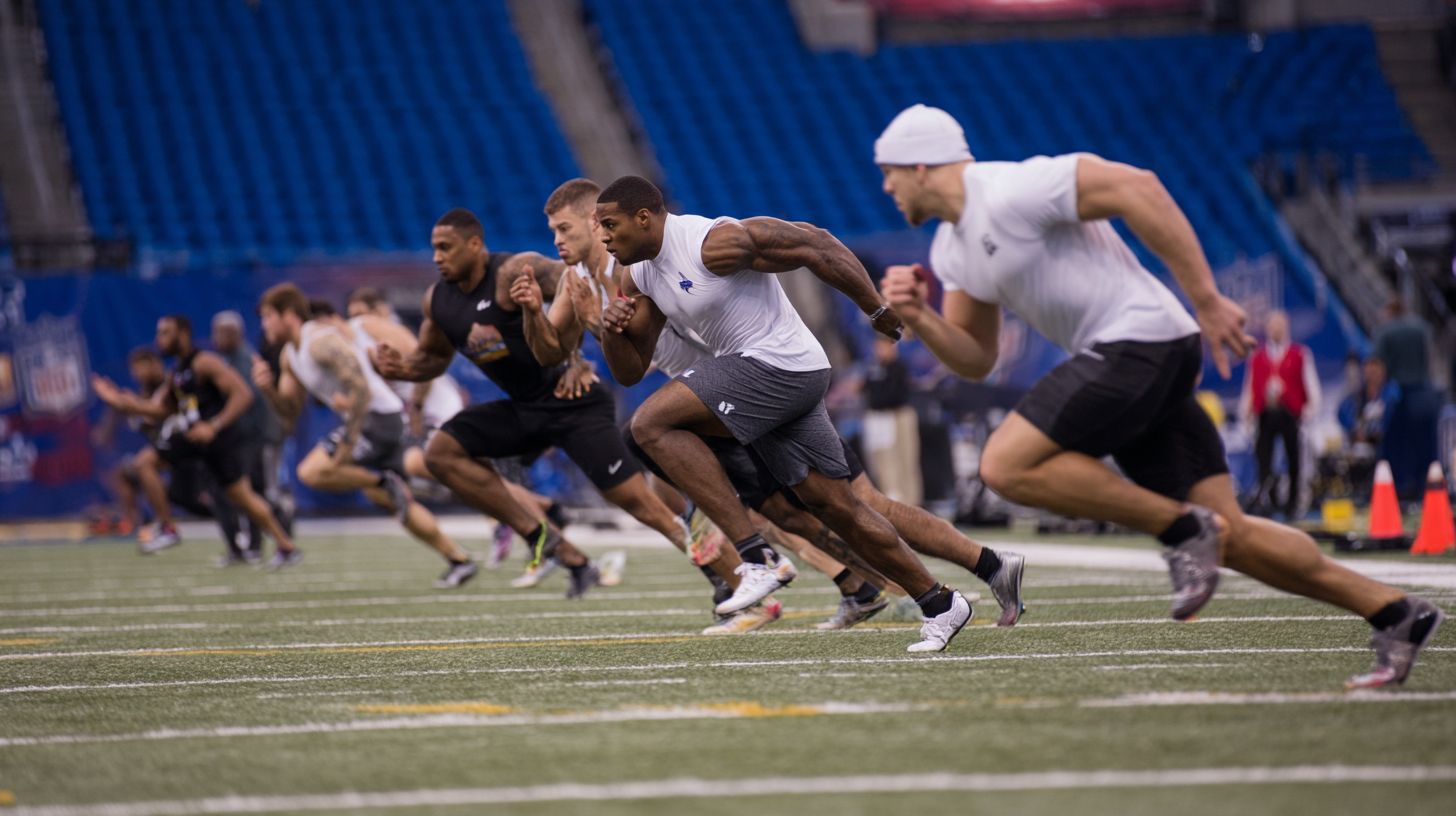
As the whistle blows on the football combine results, future stars sprint into the spotlight, their 40-yard dashes and bench presses etching legacies in mere seconds.
This pivotal event shapes draft destinies by measuring speed, strength, and agility against historical benchmarks. From 2024 class highlights and positional breakdowns to top records, draft impacts, and emerging trends, discover which metrics truly predict NFL success-and who might surprise in the upcoming draft.
Purpose and Historical Context

Established in 1982 by NFL Scouts Inc., the football combine standardized player evaluation after teams complained about inconsistent pro day measurements. Before this, scouts faced challenges comparing draft prospects due to varying testing conditions across colleges. The event created a uniform platform for player measurements like height, weight, arm length, and hand size.
In 1985, the Combine moved to Indianapolis, settling at venues like the Hoosier Dome before Lucas Oil Stadium became its home. This shift improved logistics for combine invitees and medical checks. It allowed better focus on athletic testing including the 40-yard dash, bench press, and vertical jump.
The 2000s brought a TV coverage boom via NFL Network, highlighting on-field workouts and positional drills like the gauntlet drill for wide receivers. Fans watched top performers in real time, boosting interest in combine results. Analyst rankings and mock drafts followed closely, influencing draft stock.
Looking to 2025, projected changes may expand digital coverage and include more underclassmen or small school talents. Historical archives on NFL.com detail evolution from basic scouting combine to a multi-day spectacle. Nearly all Pro Bowl players have attended, underscoring its role in spotting elite athleticism.
Event Structure and Timing
The 2025 NFL Combine spans February 26-March 2 at Lucas Oil Stadium with Thursday arrivals, Friday weigh-ins, Saturday-Sunday positional drills, and Monday-Tuesday athletic testing. This structure lets draft prospects showcase their skills in a organized way. Fans can follow along via NFL Network broadcasts.
Gates at Lucas Oil Stadium open early each day, typically around 8 a.m. EST for general admission. VIP sessions offer premium viewing for scouts and media, starting with player interviews. These timings help fans plan their visits to see combine invitees up close.
Positional groups rotate through on-field workouts, like the gauntlet drill for wide receivers or bag drills for offensive linemen. Medical checks happen alongside, evaluating injury concerns for prospects. This setup builds excitement around player measurements and athletic performance.
| Date | Events | Broadcast (EST) |
|---|---|---|
| Feb 26 (Thu) | Arrivals, interviews, medical checks | NFL Network, 2-7 p.m. |
| Feb 27 (Fri) | Weigh-ins, measurements (height, weight, arm length, hand size, wingspan) | NFL Network, 2-7 p.m. |
| Feb 28 (Sat) | QB, WR, TE, RB positional drills | NFL Network, 1-8 p.m. |
| Mar 1 (Sun) | OL, DL positional drills | NFL Network, 1-8 p.m. |
| Mar 2 (Mon) | LB, DB, S positional drills; start of athletic testing | NFL Network, 12-6 p.m. |
| Mar 3 (Tue) | Athletic testing (40-yard dash, bench press, vertical jump, broad jump, three-cone drill, 20-yard shuttle, 60-yard shuttle) | NFL Network, 12-7 p.m. |
Official results from combine testing post quickly online, influencing draft stock. Watch for top performers in speed and agility events. Analysts break down impacts on mock drafts during coverage.
Key Combine Events and Drills
Seven core drills test speed, strength, explosiveness, and change-of-direction ability with electronic timing ensuring.01-second accuracy. These events include the 40-yard dash, bench press, vertical jump, broad jump, 3-cone drill, 20-yard shuttle, and 60-yard shuttle. NFL combine results from these drills shape draft stock for prospects at Lucas Oil Stadium in Indianapolis.
Draft prospects arrive as combine invitees ready for official measurables like height, weight, arm length, hand size, and wingspan. On-field workouts follow with positional drills such as the gauntlet for wide receivers and bag drills for linebackers. Analysts on NFL Network break down workout results alongside pro day comparisons.
Experts recommend focusing on positional averages to gauge elite athleticism. For example, cornerback combine times differ from offensive line combine reps. Historical data reveals combine warriors who boost draft projections from day 3 picks to day 1 selections.
| Drill | Distance/Reps | Equipment | Primary Muscles Tested |
|---|---|---|---|
| 40-Yard Dash | 40 yards | FieldTurf, laser timing | Quadriceps, hamstrings, glutes |
| Bench Press | 225 lbs max reps | Official benches, 32″ grip | Chest, triceps, shoulders |
| Vertical Jump | Standing leap | Vertec device | Calves, quads, glutes |
| Broad Jump | Standing long jump | Takeoff line, tape measure | Glutes, hamstrings, quads |
| 3-Cone Drill | 5x5x5 yards | Cones, electronic gates | Core, hips, ankles |
| 20-Yard Shuttle | 5-10-5 yards | Cones, timing gates | Adductors, core, calves |
| 60-Yard Shuttle | 5-10-15 yards both ways | Cones, timing gates | Full lower body, conditioning |
40-Yard Dash
The 40-yard dash measures top-end speed across 40 yards with laser timing from 10-yard split through finish line. Splits at 10, 20, and 40 yards highlight early burst and sustained pace on FieldTurf. John Ross set the record at 4.22 seconds in 2017, a mark chased by wide receiver combine stars.
Average positional times vary, with running back combine prospects often under 4.5 seconds and defensive line combine athletes around 4.8. Verified times impact draft stock, turning production guys into rising prospects. Hamstring pulls during testing raise injury concerns for scouts.
Top performers train with pre-combine workouts emphasizing start technique. Video analysis of the fastest 40s shows low pad level and arm drive. Combine coverage on NFL Network recaps these runs alongside mock drafts.
| Position | Average Time |
|---|---|
| Quarterback | 4.80s |
| Running Back | 4.50s |
| Wide Receiver | 4.45s |
| Cornerback | 4.45s |
2024 NFL Combine Fastest 40-Yard Dash Times (Top 10)
#u7ao1kun.bar-container { position: relative; overflow: visible!important; } #u7ao1kun.bar-value { position: absolute!important; left: 50%!important; top: 50%!important; transform: translate(-50%, -50%)!important; color: white!important; font-weight: 700!important; font-size: 14px!important; white-space: nowrap!important; background: rgba(0, 0, 0, 0.7)!important; padding: 4px 12px!important; border-radius: 20px!important; z-index: 30!important; text-shadow: 0 1px 2px rgba(0, 0, 0, 0.3)!important; pointer-events: none!important; display: inline-block!important; } #u7ao1kun.animated-bar { z-index: 1!important; } @media (max-width: 768px) { #u7ao1kun { padding: 16px!important; } #u7ao1kun h2 { font-size: 24px!important; } #u7ao1kun h4 { font-size: 16px!important; } #u7ao1kun.bar-label { font-size: 12px!important; } #u7ao1kun.metric-card { padding: 20px!important; } #u7ao1kun.bar-value { font-size: 13px!important; padding: 3px 10px!important; } } @media (max-width: 480px) { #u7ao1kun { padding: 12px!important; } #u7ao1kun h2 { font-size: 20px!important; } #u7ao1kun h4 { font-size: 14px!important; } #u7ao1kun.bar-label { font-size: 11px!important; margin-bottom: 6px!important; } #u7ao1kun.bar-value { font-size: 12px!important; padding: 2px 8px!important; min-width: 45px!important; text-align: center!important; } #u7ao1kun.bar-container { height: 36px!important; overflow: visible!important; } }
2024 NFL Combine Fastest 40-Yard Dash Times (Top 10)
40-Yard Dash (seconds): Top Performers
(function() { setTimeout(function() { var bars = document.querySelectorAll(‘[class*=”animated-bar-u7ao1kun”]’); bars.forEach(function(bar) { var width = bar.getAttribute(‘data-width’); if (width) { bar.style.width = width + ‘%’; } }); }, 100); })();
The 2024 NFL Combine Fastest 40-Yard Dash Times (Top 10) showcases elite speed from standout prospects, with times measured in seconds. This metric is crucial for evaluating athleticism, especially for positions like wide receivers (WR) and cornerbacks (CB), where speed directly impacts draft stock and NFL potential.
Xavier Worthy (WR, Texas) set a new record at 4.21 seconds, shattering previous benchmarks and marking him as a top speed threat. Following closely, Nate Wiggins (CB, Clemson) clocked 4.28 seconds, highlighting his shutdown potential. Tied at 4.33 seconds are Quinyon Mitchell (CB, Toledo) and Brian Thomas Jr. (WR, LSU), demonstrating speed across skill positions.
- 4.34 seconds: Decamerion Richardson (CB, Miss St) and Adonai Mitchell (WR, Texas), blending speed with positional versatility.
- 4.36 seconds: Devontez Walker (WR, UNC) and Nehemiah Pritchett (CB, Auburn), reinforcing WR and CB dominance.
- 4.38 seconds: Jaylen Wright (RB, Tennessee) and Jacob Cowing (WR, Arizona), with the running back adding burst to the list.
These times, primarily from WRs and CBs, reflect the premium on speed in modern NFL offenses and defenses. Worthy’s record-breaking run elevates his draft projection, while the cluster around 4.3-4.38 seconds signals a deep class of burners capable of stretching fields or covering deep threats.
Bench Press
Linemen perform maximum reps at 225 pounds using official NFL-approved benches and bars. Total weight reaches 270 pounds with a 45-pound bar plus plates and a 32-inch grip width. No rest periods between reps test upper-body endurance for offensive line combine and defensive line combine groups.
Stephen Paea holds the record with 49 reps from 2011, showcasing freakish strength. Combine testing reveals scheme fit for power schemes over zone blocking. Underclassmen often skip to preserve health, shifting focus to pro day bench results.
Technique matters with full range of motion and controlled tempo. Scouts compare reps to positional benchmarks, elevating combine snubs to undrafted free agents with strong showings. Post-combine analysis weighs strength against athleticism.
| Top Performer | Reps | Year |
|---|---|---|
| Stephen Paea | 49 | 2011 |
| Russell Okung | 41 | 2010 |
| Vatony Sio | 40 | 2015 |
Vertical Jump
Prospects leap from standing position with Vertec device measuring reach to highest touch point. Thirty-six plastic vanes spaced half-inch apart ensure precision, with no-step rules enforcing a clean jump. This drill tests lower-body explosiveness for all positions.
Gerald Sensabaugh owns the all-time mark at 46 inches, blending dip and drive technique. Positional records highlight safety combine standouts and linebacker combine athletes. Technique breakdown emphasizes arm swing and plantar flexion for max height.
Averages guide expectations, with big school SEC combine players often topping small school marks. Player measurements pair with jumps to assess upside potential. Medical checks flag prior knee issues affecting vertical output.
| Position | Record |
|---|---|
| Safety | 46″ |
| Cornerback | 44″ |
| Wide Receiver | 43.5″ |
Broad Jump
Standing long jump tests lower-body power with measurement from takeoff line to heel landing. Foul rules demand two-foot contact inside the line and no hopping on landing. This event complements vertical jump for explosiveness profiles.
Byron Jones set the record at 12 feet 3 inches in 2015, a benchmark for draft prospects. Positional averages show cornerback combine leaders around 10 feet 6 inches. Progression photos illustrate explosive hip extension.
Training focuses on squat jumps and single-leg bounds in pre-combine workouts. Scouts value broad jump for scheme fit in gap schemes. Combine participants use it to counter weak 40 times with verified power.
| Position | Average |
|---|---|
| Cornerback | 10’6″ |
| Wide Receiver | 10’4″ |
| Running Back | 10’2″ |
3-Cone Drill
Navigate three cones in L-pattern testing change-of-direction speed and balance. Exact spacing forms a 5-yard by 5-yard by 5-yard equilateral triangle with electronic gates. Tight turns demand hip fluidity vital for cornerback combine and safety combine drills.
KeiVarae Russell holds the record at 6.66 seconds from 2016. Setup requires precise cone placement for fair official results. Technique videos stress plant-and-cut mechanics over raw speed.
This drill correlates with on-field agility in star drills and wave drills. Linebacker combine prospects shine here despite slower 40s. Analysts rank it high for production vs athleticism debates.
20-Yard Shuttle
Short shuttle runs 5 yards out-and-back four times testing lateral quickness. Total distance hits 20 yards with touches at 5 and 10 yards marked by cones. It stresses deceleration vital for NFL change of direction.
Renaldo Nehemiah’s record stands at 3.89 seconds from the 1980s. Comparison charts show strong correlation with 3-cone drill at r=0.78. Wide receiver combine and defensive back groups prioritize shuttle times.
Experts recommend mirror drills in combine training for quick feet. Positional benchmarks separate elite athleticism from average. Falling stocks often trace to poor shuttle runs amid solid measurables.
| Drill Pair | Correlation |
|---|---|
| 20-Yard Shuttle vs 3-Cone | r=0.78 |
60-Yard Shuttle
Long shuttle adds conditioning element with 5-10-15 yard touches both directions. Full path covers 60 yards total, demanding endurance alongside agility. It tests sustained quickness under fatigue.
Renaldo Nehemiah again holds the record at 10.92 seconds. Rarely tested now due to injury risks and overlap with other shuttles. Positional relevance lingers for safety combine and linebacker combine evaluations.
Decline stems from focus on shorter, explosive tests matching game demands. Historical data aids post-combine analysis for veterans. Combine schedule at Indianapolis prioritizes fresher athletes for core drills.
Interpreting Combine Metrics
Raw numbers mean little without positional context. Elite WR 40s differ from elite DT benchmarks. Football combine results gain meaning when compared to position-specific standards.
These metrics reveal athletic performance and draft stock potential. Scouts weigh speed, agility, strength, and explosiveness against historical data. Understanding benchmarks helps fans and analysts spot combine warriors from average performers.
Subsections below detail standards for key drills. Use these to evaluate NFL combine invitees and pro day results. Positional averages highlight gaps between top performers and the field.
Focus on verified times and official measurables from Lucas Oil Stadium. Combine with player measurements like height, weight, and arm length for full context on draft prospects.
Speed and Agility Benchmarks
Elite WRs run 4.4s 40s while top DTs excel at 5.0s with superior shuttle times. Speed and agility benchmarks vary by position in NFL combine testing. These drills test burst, change of direction, and short-area quickness.
The 40-yard dash measures straight-line speed for skill positions. Three-cone drill and 20-yard shuttle assess agility for backs and DBs. 60-yard shuttle evaluates endurance in lateral movements.
| Position | Drill | Elite | Average | Poor | Example Player |
|---|---|---|---|---|---|
| QB | 40-yard dash | 4.6s | 4.8s | 5.0s+ | Patrick Mahomes |
| QB | 3-cone | 6.9s | 7.2s | 7.5s+ | Patrick Mahomes |
| QB | 20-yard shuttle | 4.2s | 4.4s | 4.6s+ | Patrick Mahomes |
| QB | 60-yard shuttle | 11.5s | 11.9s | 12.3s+ | Patrick Mahomes |
| RB | 40-yard dash | 4.4s | 4.55s | 4.7s+ | Saquon Barkley |
| RB | 3-cone | 6.8s | 7.0s | 7.2s+ | Saquon Barkley |
| RB | 20-yard shuttle | 4.1s | 4.25s | 4.4s+ | Saquon Barkley |
| RB | 60-yard shuttle | 11.2s | 11.6s | 12.0s+ | Saquon Barkley |
| WR | 40-yard dash | 4.4s | 4.5s | 4.6s+ | John Ross |
| WR | 3-cone | 6.7s | 6.9s | 7.1s+ | John Ross |
| WR | 20-yard shuttle | 4.0s | 4.15s | 4.3s+ | John Ross |
| WR | 60-yard shuttle | 11.0s | 11.4s | 11.8s+ | John Ross |
| TE | 40-yard dash | 4.6s | 4.75s | 4.9s+ | George Kittle |
| TE | 3-cone | 6.9s | 7.1s | 7.4s+ | George Kittle |
| TE | 20-yard shuttle | 4.2s | 4.35s | 4.5s+ | George Kittle |
| TE | 60-yard shuttle | 11.5s | 11.9s | 12.3s+ | George Kittle |
| OL | 40-yard dash | 5.1s | 5.3s | 5.5s+ | Joe Thomas |
| OL | 3-cone | 7.7s | 8.0s | 8.3s+ | Joe Thomas |
| OL | 20-yard shuttle | 4.7s | 4.9s | 5.1s+ | Joe Thomas |
| OL | 60-yard shuttle | 12.2s | 12.6s | 13.0s+ | Joe Thomas |
| DL | 40-yard dash | 4.8s | 5.0s | 5.2s+ | Aaron Donald |
| DL | 3-cone | 7.1s | 7.4s | 7.7s+ | Aaron Donald |
| DL | 20-yard shuttle | 4.4s | 4.6s | 4.8s+ | Aaron Donald |
| DL | 60-yard shuttle | 11.8s | 12.2s | 12.6s+ | Aaron Donald |
| EDGE | 40-yard dash | 4.6s | 4.75s | 4.9s+ | Myles Garrett |
| EDGE | 3-cone | 7.0s | 7.2s | 7.5s+ | Myles Garrett |
| EDGE | 20-yard shuttle | 4.2s | 4.35s | 4.5s+ | Myles Garrett |
| EDGE | 60-yard shuttle | 11.5s | 11.9s | 12.3s+ | Myles Garrett |
| LB | 40-yard dash | 4.6s | 4.75s | 4.9s+ | Levon Kirkland |
| LB | 3-cone | 7.0s | 7.2s | 7.5s+ | Levon Kirkland |
| LB | 20-yard shuttle | 4.2s | 4.35s | 4.5s+ | Levon Kirkland |
| LB | 60-yard shuttle | 11.5s | 11.9s | 12.3s+ | Levon Kirkland |
| CB | 40-yard dash | 4.4s | 4.5s | 4.6s+ | Johnathan Joseph |
| CB | 3-cone | 6.8s | 7.0s | 7.2s+ | Johnathan Joseph |
| CB | 20-yard shuttle | 4.0s | 4.15s | 4.3s+ | Johnathan Joseph |
| CB | 60-yard shuttle | 11.2s | 11.5s | 11.8s+ | Johnathan Joseph |
| S | 40-yard dash | 4.5s | 4.55s | 4.65s+ | Eric Weddle |
| S | 3-cone | 6.9s | 7.1s | 7.3s+ | Eric Weddle |
| S | 20-yard shuttle | 4.1s | 4.25s | 4.4s+ | Eric Weddle |
| S | 60-yard shuttle | 11.3s | 11.7s | 12.1s+ | Eric Weddle |
Green highlights mark elite athleticism. Compare prospects to these to gauge upside. Poor times raise injury concerns or scheme fit issues.
Strength and Power Standards
OL/DL need 30+ bench reps while DBs prioritize 40+” verticals for position-specific explosiveness. Strength and power standards define combine testing for linemen and backs. These metrics show raw power and lower-body explosion.
Bench press tests upper-body endurance for trenches. Vertical jump and broad jump measure explosiveness for all positions. Elite marks place players in the 90th percentile.
| Position | Bench (reps) | Vert (inches) | Broad (ft) | Elite Example |
|---|---|---|---|---|
| QB | 20 (90th) | 34 (90th) | 10-0 (90th) | Cam Newton |
| RB | 25 (90th) | 38 (90th) | 10-6 (90th) | LeSean McCoy |
| WR | 20 (90th) | 40 (90th) | 10-8 (90th) | Everson Griffen |
| TE | 25 (90th) | 36 (90th) | 10-4 (90th) | Kyle Rudolph |
| OL | 32 (90th) | 30 (90th) | 9-6 (90th) | Brandon Scherff |
| DL | 30 (90th) | 34 (90th) | 10-2 (90th) | J.J. Watt |
| EDGE | 28 (90th) | 36 (90th) | 10-4 (90th) | Von Miller |
| LB | 27 (90th) | 36 (90th) | 10-4 (90th) | Levon Kirkland |
| CB | 18 (90th) | 40 (90th) | 10-8 (90th) | Chris McKenzie |
| S | 22 (90th) | 38 (90th) | 10-6 (90th) | Ronald Darby |
Match reps and jumps to positional needs. High verticals boost DB draft projections. Power scores signal day 1 potential or UDFA risks.
Positional Averages and Expectations
2023 data shows QBs average 4.82s 40s, EDGE rushers hit 27 bench reps. Positional averages from NFL.com official stats set expectations for combine participants. Compare workout results to spot rising prospects or falling stocks.
These benchmarks draw from historical data at Indianapolis events. Biggest gaps appear in speed for WRs versus strength for OL. Use them for post-combine analysis and mock drafts.
| Position | 40YD | Bench | Vert | Broad | 3Cone | 20Shuttle | 60Shuttle | ||||||||||||||||||||||||||||||||||||||||||||||||||||||||||||||||||||||||||||||||||||||||||||||||||||||||||||||||||||||||||||||||||||||||||||||||||||||||||||||||||||||||||||||||||||||||||||||||||||||||||||||||||||||||||||||||||||||||||||||||||||||||||||||||||||||||||||||||||||||||||||||||||||||||||||||||||||||||||||||||||||||||||||||||||||||||||||||||||
|---|---|---|---|---|---|---|---|---|---|---|---|---|---|---|---|---|---|---|---|---|---|---|---|---|---|---|---|---|---|---|---|---|---|---|---|---|---|---|---|---|---|---|---|---|---|---|---|---|---|---|---|---|---|---|---|---|---|---|---|---|---|---|---|---|---|---|---|---|---|---|---|---|---|---|---|---|---|---|---|---|---|---|---|---|---|---|---|---|---|---|---|---|---|---|---|---|---|---|---|---|---|---|---|---|---|---|---|---|---|---|---|---|---|---|---|---|---|---|---|---|---|---|---|---|---|---|---|---|---|---|---|---|---|---|---|---|---|---|---|---|---|---|---|---|---|---|---|---|---|---|---|---|---|---|---|---|---|---|---|---|---|---|---|---|---|---|---|---|---|---|---|---|---|---|---|---|---|---|---|---|---|---|---|---|---|---|---|---|---|---|---|---|---|---|---|---|---|---|---|---|---|---|---|---|---|---|---|---|---|---|---|---|---|---|---|---|---|---|---|---|---|---|---|---|---|---|---|---|---|---|---|---|---|---|---|---|---|---|---|---|---|---|---|---|---|---|---|---|---|---|---|---|---|---|---|---|---|---|---|---|---|---|---|---|---|---|---|---|---|---|---|---|---|---|---|---|---|---|---|---|---|---|---|---|---|---|---|---|---|---|---|---|---|---|---|---|---|---|---|---|---|---|---|---|---|---|---|---|---|---|---|---|---|---|---|---|---|---|---|---|---|---|---|---|---|---|---|---|---|---|---|---|---|---|---|---|---|---|---|---|---|---|---|---|---|---|---|---|---|---|---|---|---|---|---|---|---|---|---|---|---|
| QB | 4.82 | 18 | 28 | 9-4 | 7.2 | 4.45 | 12.0 | ||||||||||||||||||||||||||||||||||||||||||||||||||||||||||||||||||||||||||||||||||||||||||||||||||||||||||||||||||||||||||||||||||||||||||||||||||||||||||||||||||||||||||||||||||||||||||||||||||||||||||||||||||||||||||||||||||||||||||||||||||||||||||||||||||||||||||||||||||||||||||||||||||||||||||||||||||||||||||||||||||||||||||||||||||||||||||||||||||
| RB | 4.52 | 22 | 34 | 10-2 | 7.0 | 4.25 | 11.6 | ||||||||||||||||||||||||||||||||||||||||||||||||||||||||||||||||||||||||||||||||||||||||||||||||||||||||||||||||||||||||||||||||||||||||||||||||||||||||||||||||||||||||||||||||||||||||||||||||||||||||||||||||||||||||||||||||||||||||||||||||||||||||||||||||||||||||||||||||||||||||||||||||||||||||||||||||||||||||||||||||||||||||||||||||||||||||||||||||||
| WR | 4.50 | 14 | 35 | 10-4
Top Historical PerformancesCombine records showcase athletic freaks who redefined positional standards. These top historical performances highlight elite speed, strength, and explosiveness from NFL combine testing at Lucas Oil Stadium in Indianapolis. All-time top 3 lists by drill reveal draft prospects who shattered expectations in the 40-yard dash, bench press, and jumps. Scouts use these benchmarks to compare current combinations invitees against legends. From verified times to max reps, these marks influence draft stock and scheme fit. Detailed breakdowns of each record setter show how workout results boosted their path to the NFL Draft. Historical data from official results underscores the gap between positional averages and true combine warriors. Near-misses by rising prospects keep the chase alive each year. Record-Breaking 40-Yard Dash TimesJohn Ross’s 4.22s (2017) remains untouched with Xavier Worthy’s 4.21s (2024) closest challenger. These fastest 40-yard dash times, from electronic timing only, exclude the hand-timed era for accuracy.
Slow-motion footage of Worthy’s run captures his elite athleticism, with explosive starts that wide receiver combine participants chase. Hamstring pulls often sideline others attempting sub-4.30 speeds. These times elevate draft projections, turning day 3 picks into day 1 steals. Pre-combine workouts focus on verified times to match top performers. Bench Press Rep RecordsStephen Paea’s 49 reps (2011) stands alone with no one reaching 45 since 2016. This bench press mark tests raw strength for defensive line combine and offensive line combine athletes.
Paea’s technique featured a tight grip and explosive hips, minimizing rest between reps. Top 3 performers locked elbows fully for official counts, a key in combine training. Linebacker combine reps often lag behind linemen due to body types. Strong benches signal upside potential despite injury concerns or production vs athleticism debates. Jump and Shuttle Standouts
Byron Jones owns broad jump (12’3″) while Gerald Sensabaugh’s 46″ vertical endures. These vertical jump and jump records measure explosiveness for all positions at the scouting combine.
Jones’s broad jump used a low center of gravity for max distance, ideal for cornerback combine drills like the gauntlet. Sensabaugh’s vertical came from quick ankle flexion in pre-combine workouts. Shuttle records test agility, with near-misses by safety combine stars falling short by seconds. These metrics predict on-field workouts success in star drill or wave drill. Analysis of Recent Combine ResultsThe 2024 class featured 15 sub-4.5s 40s and 8 players over 40″ verticals. This group showed elite athletic performance across speed, explosiveness, and agility drills at Lucas Oil Stadium in Indianapolis. Draft prospects impressed NFL scouts with verified times and official measurables. Top metrics included standout 40-yard dash runs under 4.3 seconds, bench press reps exceeding 30, and broad jumps over 10 feet. Position-specific testing highlighted differences in positional averages, from quarterback combine accuracy to defensive line strength. These combine results shifted mock drafts and analyst rankings. Upcoming sections break down position-specific analysis for rising stars and surprises. Expect insights on how player measurements like height, weight, arm length, and wingspan influenced scheme fit. On-field workouts and positional drills added context to raw athletic testing. Experts note that combine testing reveals upside potential beyond college production. Hamstring pulls and injury concerns affected some, while others solidified Day 1 pick status. This analysis draws from official results and post-combine coverage on NFL Network. 2024 Class HighlightsXavier Worthy (4.21s), Rome Odunze (41.72″ vertical), and Byron Murphy II (4.87s) dominated 2024 testing. These top performers set benchmarks in speed, explosiveness, and short-area quickness. Their workouts influenced draft stock significantly.
These workout results came from official NFL.com timings during on-field sessions. Vertical jumps and broad jumps measured explosiveness, while three-cone drill and 20-yard shuttle tested agility. Such performances often lead to pro day follow-ups. Combine invitees from SEC and Big Ten dominated, but small school athletes like Mitchell proved elite athleticism. Bench press highlighted strength for offensive line combine and linebacker combine participants. Historical data shows these metrics predict NFL success. Rising Stars by PositionCB Quinyon Mitchell’s 4.33s boosted him to top-10 projection after Day 2. His combine results showcased speed and agility ideal for cornerback combine drills like the gauntlet. Mock drafts adjusted upward for several prospects.
These rising prospects gained draft stock through verified times in 40-yard dash and shuttles. Pre-combine workouts built hype, but official measurables confirmed athletic testing. Positional benchmarks separated elite from average. Wide receiver combine stars like McConkey excelled in wave drills, boosting Day 2 projections. Linebackers showed agility in star drills. Such movements highlight production versus athleticism debates in scouting. Surprises and DisappointmentsOL Amarius Mims skipped 40s but measured 6’8″ 340lb; WR Jalen McMillan ran 4.54s vs expected 4.4s. These combine results created buzz and questions around draft stock. Injury withdrawals numbered 12 in 2024, impacting participation.
Biggest movers often came from unexpected metrics like hand size or wingspan. Surprises in broad jump and 60-yard shuttle revealed hidden freaks. Disappointments faced hamstring concerns during medical checks. Combine warriors like Mims relied on size for offensive line combine appeal. Falling stocks hit those missing positional averages in bag drills. Post-combine analysis from player interviews clarified motivations and scheme fit. Impact on NFL Draft ProcessResearch suggests that combine performance plays a key role in shaping NFL Draft outcomes for prospects. Academic studies on football combine results highlight moderate links between athletic testing and draft slots. Positional impact analyses show stronger ties for skill positions like wide receivers and cornerbacks compared to linemen. Teams weigh 40-yard dash times, bench press reps, and agility drills alongside game tape. A Harvard Sports Analysis study notes combine performance correlates 0.42 with draft position. This metric helps explain why draft stock rises for top performers in vertical jump or three-cone drill. Historical data from Lucas Oil Stadium events reveals patterns in combine invitees. Running backs with elite 20-yard shuttle times often see draft projections improve. Offensive linemen excelling in player measurements like arm length gain attention from scheme-fit scouts. Post-combine analysis on NFL Network influences mock drafts. Prospects like combine warriors boost their upside potential. Yet experts recommend balancing athletic performance with college production for true evaluations. Correlation to Draft PositionFirst-rounders average 1.27 standard deviations above positional means across all drills. The Harvard study visualizes drill correlations by round, with 40-yard dash showing the strongest link at r=-0.35 for skill positions. This holds for wide receiver combine and cornerback combine prospects.
Position-specific insights favor speed and explosiveness for day 1 picks. Quarterbacks with quick 60-yard shuttle times stand out in positional drills. Defensive linemen need strength benchmarks to match positional averages. Scouts track official results against historical data. Elite athleticism in drill times can elevate small-school players. Combine training often targets these metrics to align with draft prospects expectations. Pro Day Comparisons86% of top Pro Day 40s get re-run at Combine with average 0.05s slower official times. Hand-timing inflation at pro days adds about 0.1s compared to verified times from Indianapolis. This gap affects workout results credibility for teams.
Notable exceptions like Antonio Brown match times across events. Pro day stars often face scrutiny in on-field workouts. Teams prefer NFL combine data for fair positional benchmarks. Linebackers and safeties see similar slowdowns in shuttle drills. Pre-combine workouts aim to peak for official measurables. Analysts compare these to spot rising prospects or falling stocks. Medical Evaluations and Red FlagsTeams conduct 60+ medical tests over 4 days with MRI/CT scans for 15% of participants. The medical process timeline starts with arrivals and ends in re-checks. Injury concerns like hamstring pulls during testing trigger immediate flags.
Common red flags include ACL history, often dropping draft position by notable rounds. Microfracture surgery poses even larger risks for draft projections. Case studies show medical rejections turning day 2 picks into undrafted free agents. Experts recommend full disclosure in player interviews. Combine snubs sometimes benefit from cleaner medicals at pro days. Balancing production vs athleticism with health defines long-term NFL success. Positional Breakdowns
Each position demands different physical profiles. QBs prioritize accuracy over 40-time. Skill players chase speed and agility, while trench positions focus on power and strength. Skill vs trench divide shapes combine results. Running backs and wide receivers shine in explosiveness drills. Linemen prove worth through bench press reps and short shuttle times. Scouts weigh positional benchmarks against measurables like height, weight, and arm length. This breakdown reveals how draft prospects stack up in athletic testing. Quarterbacks and Skill PositionsQB Caleb Williams skipped 40s but threw 60mph+ with 65-yard deep balls. His choice highlighted how quarterback combine focus leans toward arm talent over raw speed. Only about 40% of QBs run the 40-yard dash. Skill positions like RB, WR, TE, and SS test explosiveness and agility. Vertical jump and broad jump measure burst power for separating from defenders. Three-cone drill and 20-yard shuttle gauge change-of-direction skills vital for draft prospects. Combine invitees often hit positional averages in these metrics. Top performers boost draft stock with elite times. Workout results from Lucas Oil Stadium set the tone for NFL Draft buzz.
Linemen and Defensive PlayersDT Byron Murphy II’s 4.87s 40 redefined big-man speed standards. His time among combine freaks showed defensive tackles can threaten edges. Such verified speeds alter scheme fit for NFL teams. Linemen and defensive players emphasize strength and quickness. Bench press reps test upper-body power for blocking or shedding. Short-area shuttles reveal agility for pass rush or coverage. Size-speed index combines weight and 40-time to score athletic performance. Elite scores flag upside potential despite production concerns. Historical data from Indianapolis combines guides analyst rankings. Freaks like Aaron Donald with his 4.68s 40 set records. Positional averages help spot rising prospects amid hamstring pulls or injury concerns. Post-combine analysis shifts mock drafts.
Future Projections and TrendsVirtual reality testing and GPS tracking will reshape Combine evaluation by 2030. These tools move beyond traditional 40-yard dash and bench press metrics. They capture real-time data during positional drills. Teams already pilot wearable GPS in pre-combine workouts. This tracks speed and agility in three-cone drill simulations. It reveals athletic performance under fatigue, key for draft prospects. Experts recommend integrating virtual reality for scenario-based tests. Imagine quarterbacks running the gauntlet drill in simulated games. This predicts scheme fit better than static measurables like height or wingspan. Historical data from NFL combine results will fuel AI models. Analysts project rising use of player measurements with machine learning. Expect shifts in draft stock for combine warriors showing elite explosiveness. Frequently Asked QuestionsWhat are football combine results?Football combine results refer to the performance metrics from the NFL Scouting Combine, where college players showcase their speed, strength, and agility through drills like the 40-yard dash, bench press, and vertical jump. These football combine results help teams evaluate prospects for the draft. Where can I find the latest football combine results?You can find the latest football combine results on official NFL websites, ESPN, or NFL.com’s combine section. They usually post real-time updates and full football combine results breakdowns during the annual event in Indianapolis. How important are football combine results for NFL draft prospects?Football combine results are crucial as they provide objective data on a player’s athleticism, often influencing draft stock. Standout football combine results can elevate a prospect’s ranking, while underwhelming ones might raise concerns despite college tape. What key events are included in football combine results?Key events in football combine results include the 40-yard dash, 225-pound bench press reps, broad jump, vertical jump, 3-cone drill, and shuttle run. These metrics form the core of football combine results used by scouts and analysts. Do football combine results predict NFL success?While football combine results highlight physical traits, they don’t guarantee NFL success-game film and intangibles matter more. However, elite football combine results from players like John Ross in the 40-yard dash have historically correlated with certain positions’ performance. When are football combine results typically released?Football combine results are released daily during the four-day NFL Scouting Combine event, usually held in late February. Full compilations of football combine results, including positional rankings, follow shortly after the event concludes. |